Bias-Variance: The Key to Balanced AI Models

Applied Statistics
A practical introduction to the bias-variance tradeoff, underfitting, overfitting, regularization, and model generalization in AI.
Published

October 15, 2024

Modified

June 9, 2026

Executive Summary

Many modeling failures come from getting the balance wrong.

Some models are too simple. They miss real structure and underfit the data.

Other models are too flexible. They chase noise and overfit the data.

The statistical language for this tension is the bias-variance tradeoff (James et al. 2021; Hastie et al. 2009; Domingos 2000).

This idea is one of the most important concepts in both statistics and machine learning because it explains why better fit on training data does not always lead to better prediction on new data (Hastie et al. 2009; James et al. 2021).

At the center of the tradeoff is a simple truth:

a model can be wrong because it is too rigid, or wrong because it is too unstable.

This post introduces:

  • bias and variance intuitively,
  • mean squared error decomposition,
  • simulation with polynomial regression,
  • learning curves,
  • and why this tradeoff matters for regularization, ensembles, and model selection.

The best predictive model is usually not the one that fits hardest, but the one that balances systematic error against instability.


The Bias-Variance Tradeoff Explains Why Prediction Is Hard

A model can fail in two broad ways.

It can be too simple to represent the true signal. That creates bias.

Or it can be too sensitive to sample-specific noise. That creates variance.

These two problems usually pull in opposite directions.

As flexibility increases:

  • bias often decreases,
  • but variance often increases.

As flexibility decreases:

  • variance often decreases,
  • but bias often increases.

This is why predictive modeling is rarely about maximizing fit alone. It is about finding an appropriate level of complexity.


Bias and Variance Reflect Different Kinds of Error

Bias

Bias refers to systematic error.

A high-bias model tends to miss important structure in the data repeatedly. Even across many samples, it keeps making errors in the same general direction.

This is often associated with underfitting.

Variance

Variance refers to instability.

A high-variance model may fit one sample very differently from another. Its predictions are highly sensitive to the specific data observed.

This is often associated with overfitting.

These are different failure modes. A model can be stable but wrong, or flexible but erratic.


Mean Squared Error Is Where the Tradeoff Shows Up

A common way to summarize predictive error is mean squared error (MSE).

At a high level, prediction error can be thought of as having three components:

\[ \text{MSE} = \text{Bias}^2 + \text{Variance} + \text{Irreducible Error} \]

The irreducible error is the noise in the data-generating process itself. No model can remove it completely.

That means model improvement usually depends on balancing the first two parts:

  • reducing bias without exploding variance
  • reducing variance without becoming too simplistic

This is the practical heart of model selection.


A Simple Simulation Makes the Tradeoff Visible

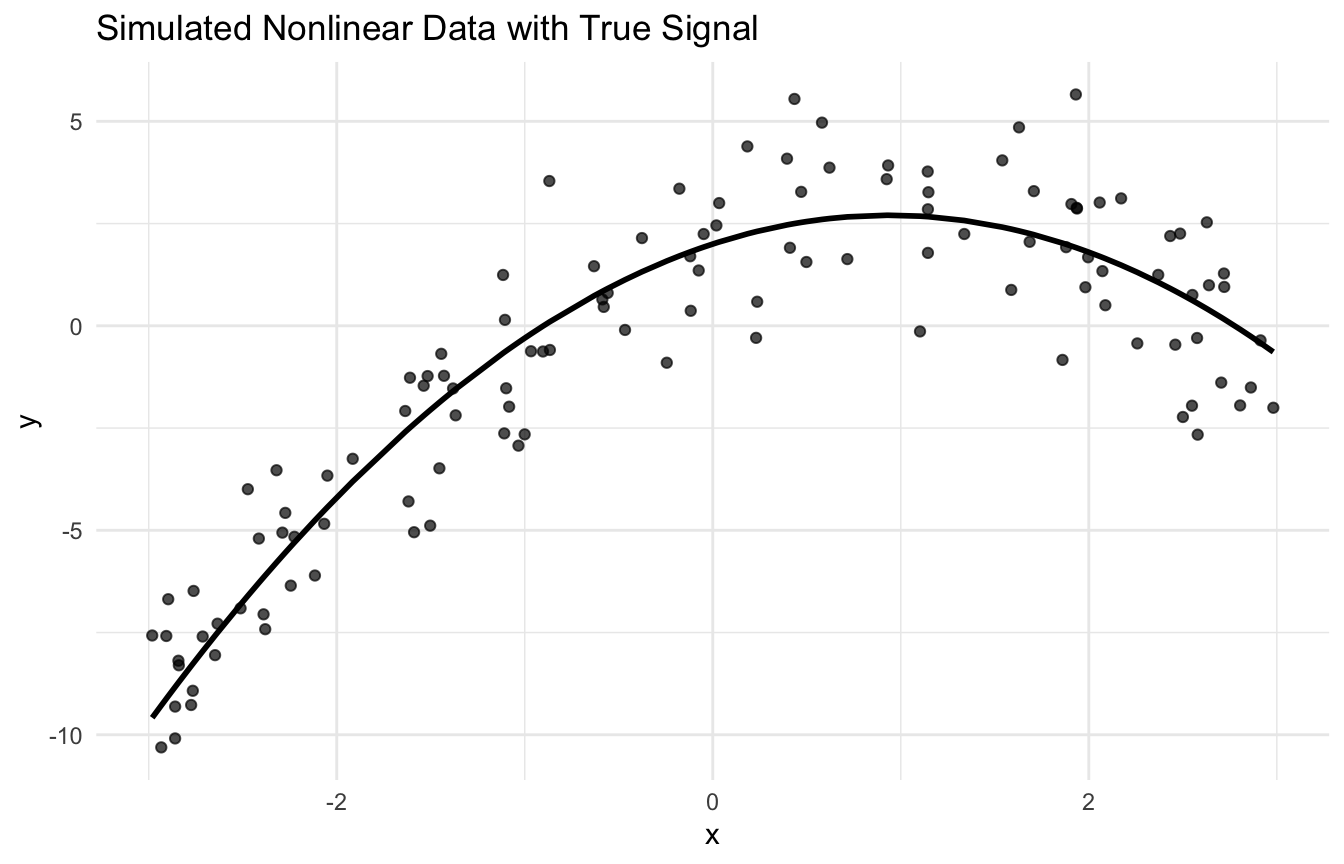
To illustrate the tradeoff, we will simulate data from a nonlinear signal and then fit polynomial regression models of different degrees.

This is a classic way to show how:

  • simple models can underfit
  • complex models can overfit
  • and intermediate models often generalize best
library(dplyr)
library(tibble)
library(ggplot2)

n <- 120

sim_df <- tibble::tibble(
  x = sort(runif(n, min = -3, max = 3))
) |>
  dplyr::mutate(
    y_true = 2 + 1.5 * x - 0.8 * x^2,
    y = y_true + rnorm(n, mean = 0, sd = 1.5)
  )

ggplot2::ggplot(sim_df, ggplot2::aes(x = x, y = y)) +
  ggplot2::geom_point(alpha = 0.7) +
  ggplot2::geom_line(ggplot2::aes(y = y_true), linewidth = 1) +
  ggplot2::labs(
    title = "Simulated Nonlinear Data with True Signal",
    x = "x",
    y = "y"
  ) +
  ggplot2::theme_minimal()

The black line is the true underlying signal. The points are noisy observations around that signal.


Underfitting Is What High Bias Looks Like

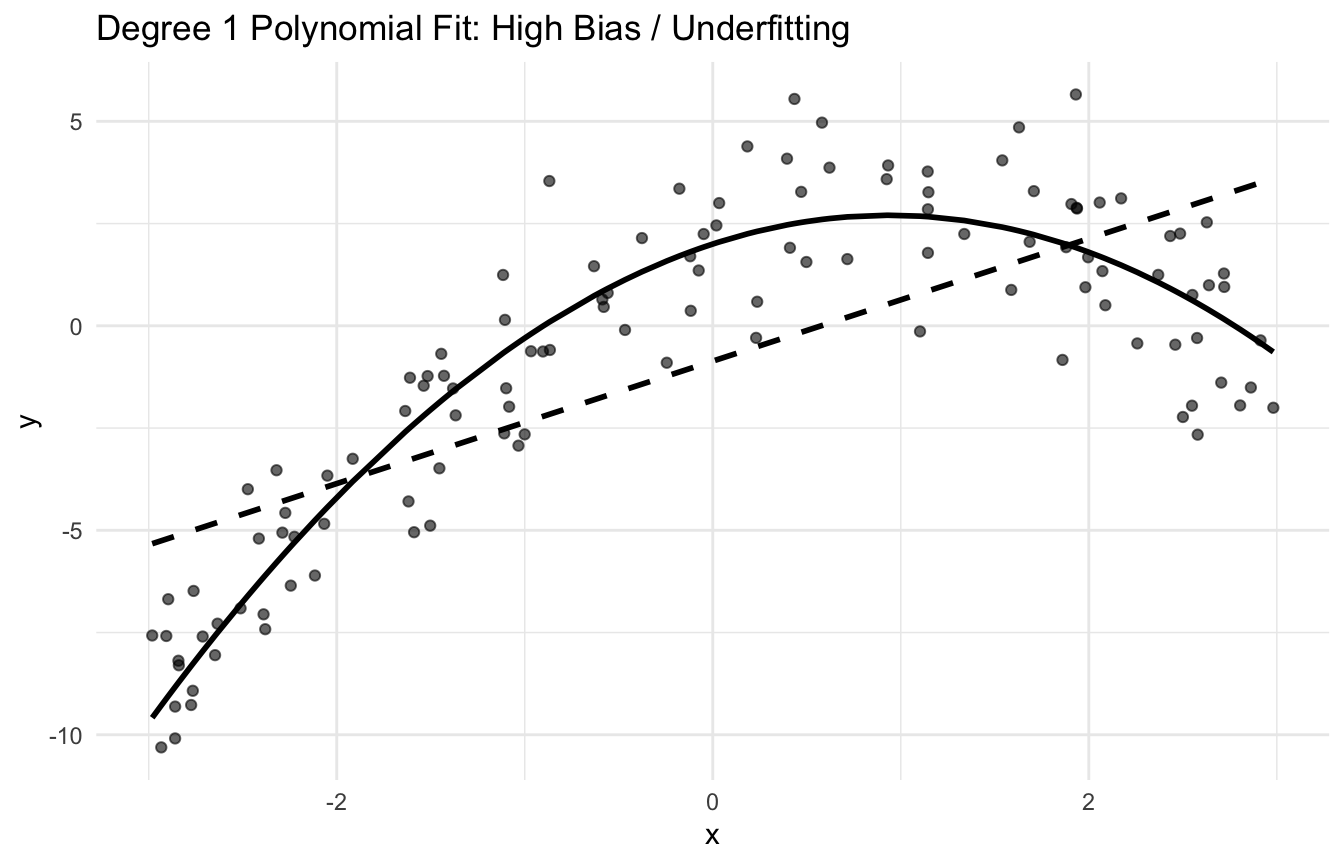
Let us begin with a model that is too simple: ordinary linear regression.

fit_deg1 <- lm(y ~ poly(x, 1, raw = TRUE), data = sim_df)

sim_df <- sim_df |>
  dplyr::mutate(
    pred_deg1 = predict(fit_deg1)
  )

ggplot2::ggplot(sim_df, ggplot2::aes(x = x, y = y)) +
  ggplot2::geom_point(alpha = 0.6) +
  ggplot2::geom_line(ggplot2::aes(y = y_true), linewidth = 1) +
  ggplot2::geom_line(ggplot2::aes(y = pred_deg1), linetype = 2, linewidth = 1) +
  ggplot2::labs(
    title = "Degree 1 Polynomial Fit: High Bias / Underfitting",
    x = "x",
    y = "y"
  ) +
  ggplot2::theme_minimal()

This model is stable, but it clearly misses the curvature in the true signal.

That is the signature of high bias.


Overfitting Is What High Variance Looks Like

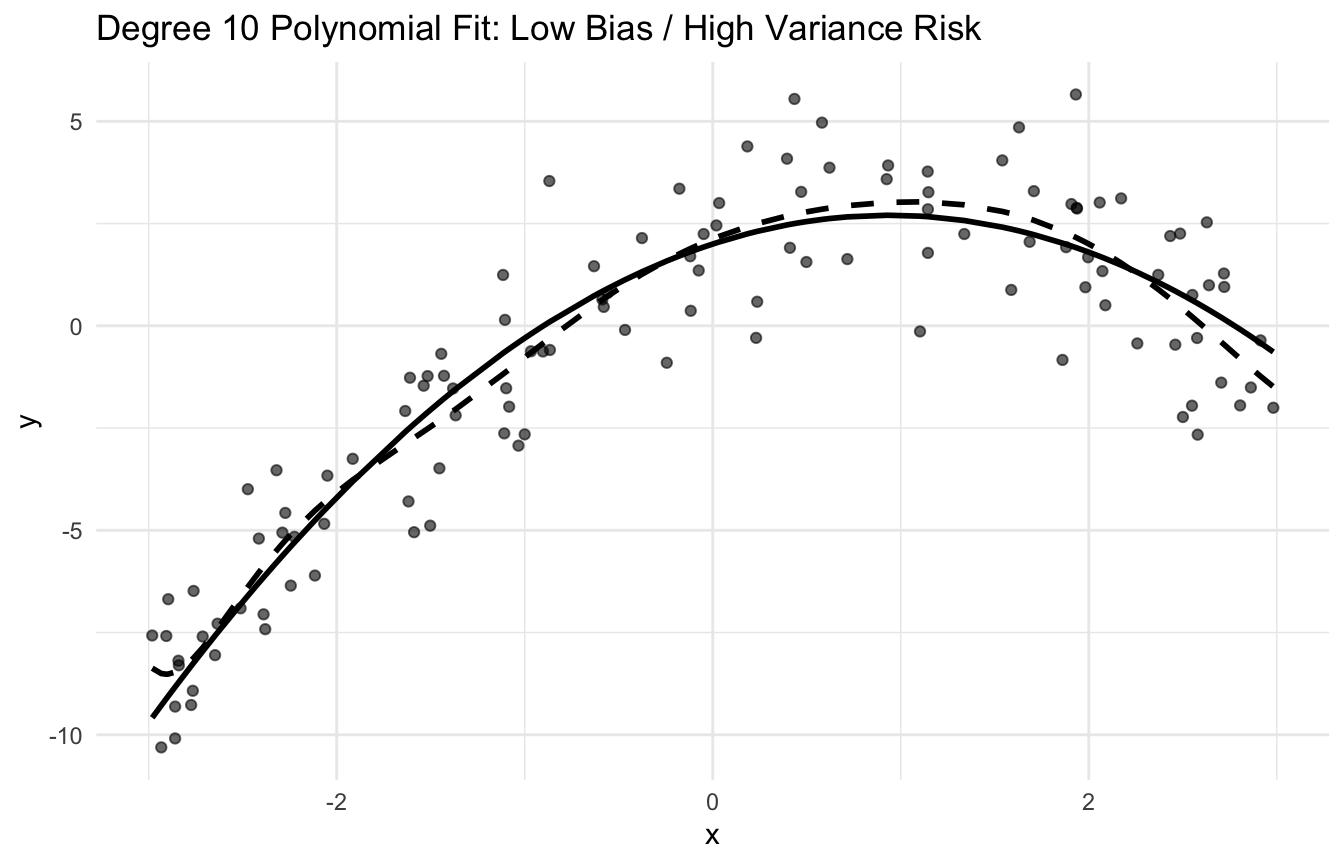
Now let us fit a much more flexible polynomial.

fit_deg10 <- lm(y ~ poly(x, 10, raw = TRUE), data = sim_df)

sim_df <- sim_df |>
  dplyr::mutate(
    pred_deg10 = predict(fit_deg10)
  )

ggplot2::ggplot(sim_df, ggplot2::aes(x = x, y = y)) +
  ggplot2::geom_point(alpha = 0.6) +
  ggplot2::geom_line(ggplot2::aes(y = y_true), linewidth = 1) +
  ggplot2::geom_line(ggplot2::aes(y = pred_deg10), linetype = 2, linewidth = 1) +
  ggplot2::labs(
    title = "Degree 10 Polynomial Fit: Low Bias / High Variance Risk",
    x = "x",
    y = "y"
  ) +
  ggplot2::theme_minimal()

This model may hug the observed data more aggressively, but that does not mean it has learned the true signal well.

A highly flexible model may fit sample-specific noise, producing unstable predictions on new data.

That is the essence of variance-driven overfitting.


An Intermediate Model Often Balances the Tradeoff Better

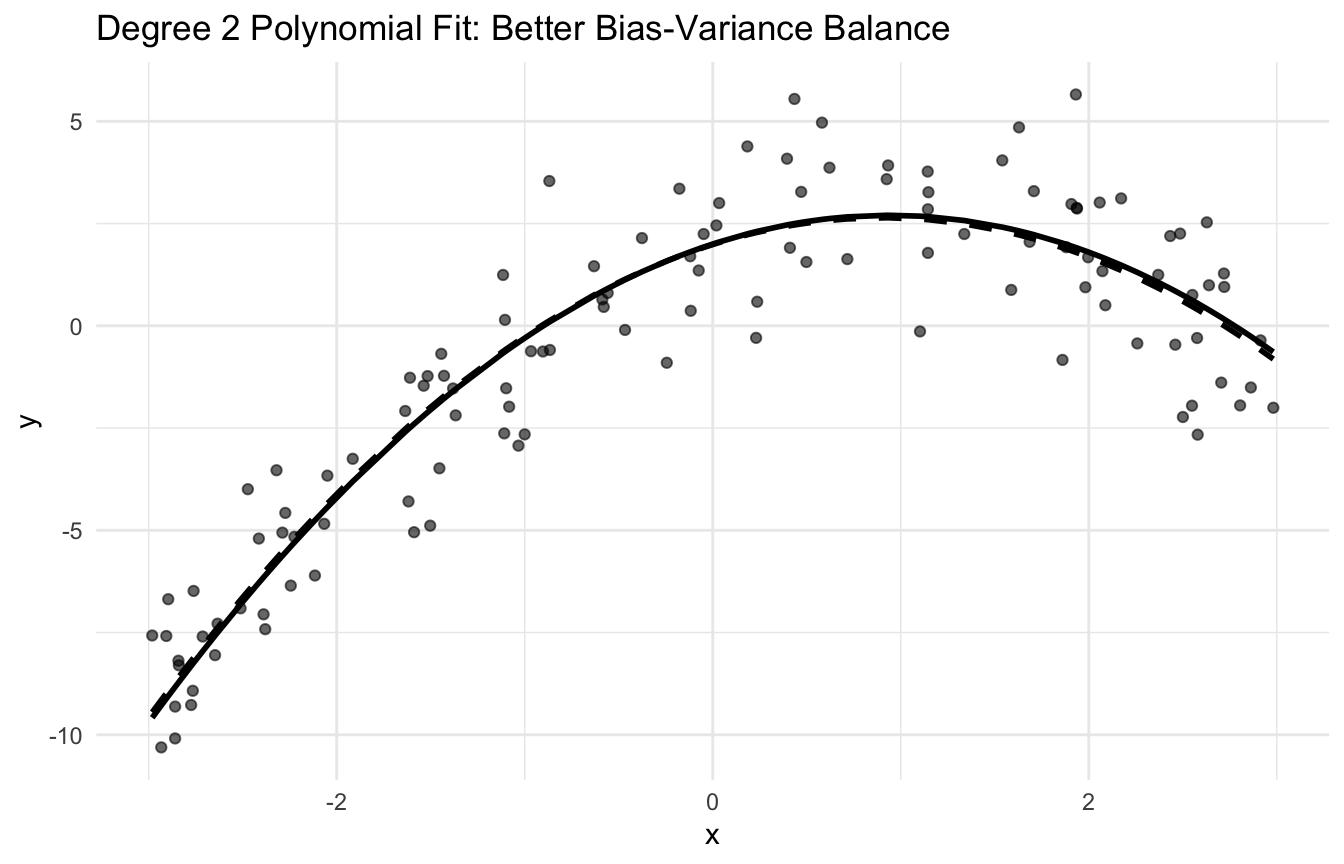
Now try a model closer to the real structure.

fit_deg2 <- lm(y ~ poly(x, 2, raw = TRUE), data = sim_df)

sim_df <- sim_df |>
  dplyr::mutate(
    pred_deg2 = predict(fit_deg2)
  )

ggplot2::ggplot(sim_df, ggplot2::aes(x = x, y = y)) +
  ggplot2::geom_point(alpha = 0.6) +
  ggplot2::geom_line(ggplot2::aes(y = y_true), linewidth = 1) +
  ggplot2::geom_line(ggplot2::aes(y = pred_deg2), linetype = 2, linewidth = 1) +
  ggplot2::labs(
    title = "Degree 2 Polynomial Fit: Better Bias-Variance Balance",
    x = "x",
    y = "y"
  ) +
  ggplot2::theme_minimal()

This fit is still not perfect, but it is much better aligned with the signal while remaining relatively stable.

This is what a good tradeoff often looks like: not the most flexible model, but the most appropriate one.


Training Error Alone Can Be Misleading

A key lesson in machine learning is that training error usually decreases as model flexibility increases.

That sounds good, but it is incomplete.

The real question is not:

how well does the model fit the data it already saw?

The real question is:

how well does the model generalize to new data?

This is why analysts compare:

  • training error
  • validation error
  • or test error

A model with extremely low training error may still perform poorly out of sample if its variance is too high.


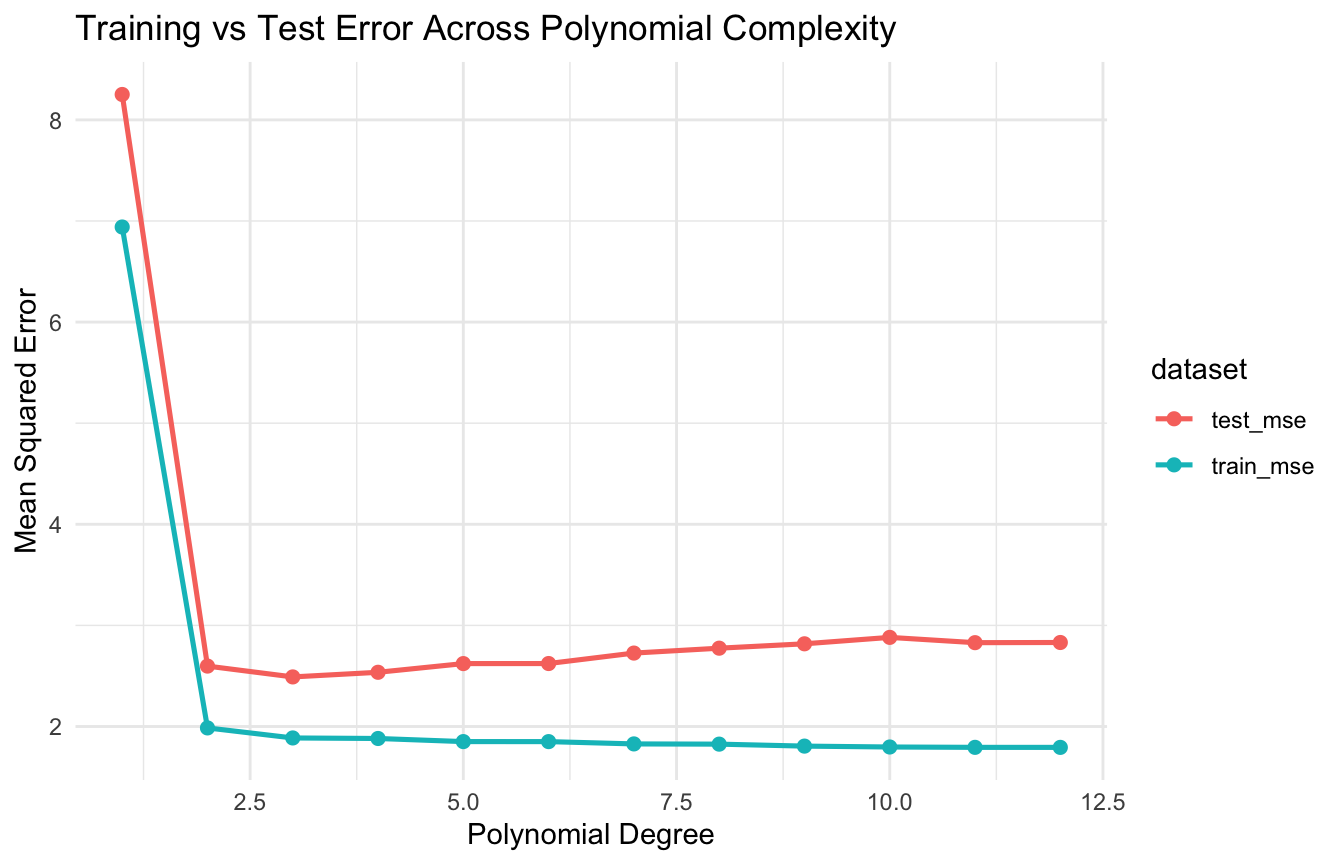
A Simulation Across Polynomial Degrees Shows the Tradeoff More Clearly

We can fit models of different degrees and compare training and test error.

set.seed(20260315)

train_idx <- sample(seq_len(nrow(sim_df)), size = 80)

train_df <- sim_df[train_idx, ]
test_df  <- sim_df[-train_idx, ]

mse_fun <- function(actual, predicted) {
  mean((actual - predicted)^2)
}

degree_results <- purrr::map_dfr(
  1:12,
  function(deg) {
    fit <- lm(y ~ poly(x, deg, raw = TRUE), data = train_df)
    
    train_pred <- predict(fit, newdata = train_df)
    test_pred  <- predict(fit, newdata = test_df)
    
    tibble::tibble(
      degree = deg,
      train_mse = mse_fun(train_df$y, train_pred),
      test_mse = mse_fun(test_df$y, test_pred)
    )
  }
)

degree_results
# A tibble: 12 × 3
   degree train_mse test_mse
    <int>     <dbl>    <dbl>
 1      1      6.94     8.25
 2      2      1.99     2.60
 3      3      1.89     2.49
 4      4      1.88     2.54
 5      5      1.85     2.62
 6      6      1.85     2.62
 7      7      1.83     2.73
 8      8      1.83     2.77
 9      9      1.81     2.82
10     10      1.80     2.88
11     11      1.79     2.83
12     12      1.79     2.83

Now visualize training and test error.

degree_results_long <- degree_results |>
  tidyr::pivot_longer(
    cols = c(train_mse, test_mse),
    names_to = "dataset",
    values_to = "mse"
  )

ggplot2::ggplot(degree_results_long, ggplot2::aes(x = degree, y = mse, color = dataset)) +
  ggplot2::geom_line(linewidth = 0.9) +
  ggplot2::geom_point(size = 2) +
  ggplot2::labs(
    title = "Training vs Test Error Across Polynomial Complexity",
    x = "Polynomial Degree",
    y = "Mean Squared Error"
  ) +
  ggplot2::theme_minimal()

This is one of the clearest visualizations of the bias-variance tradeoff.

Typically:

  • training error keeps falling
  • test error falls at first, then rises again

That rise in test error is overfitting.


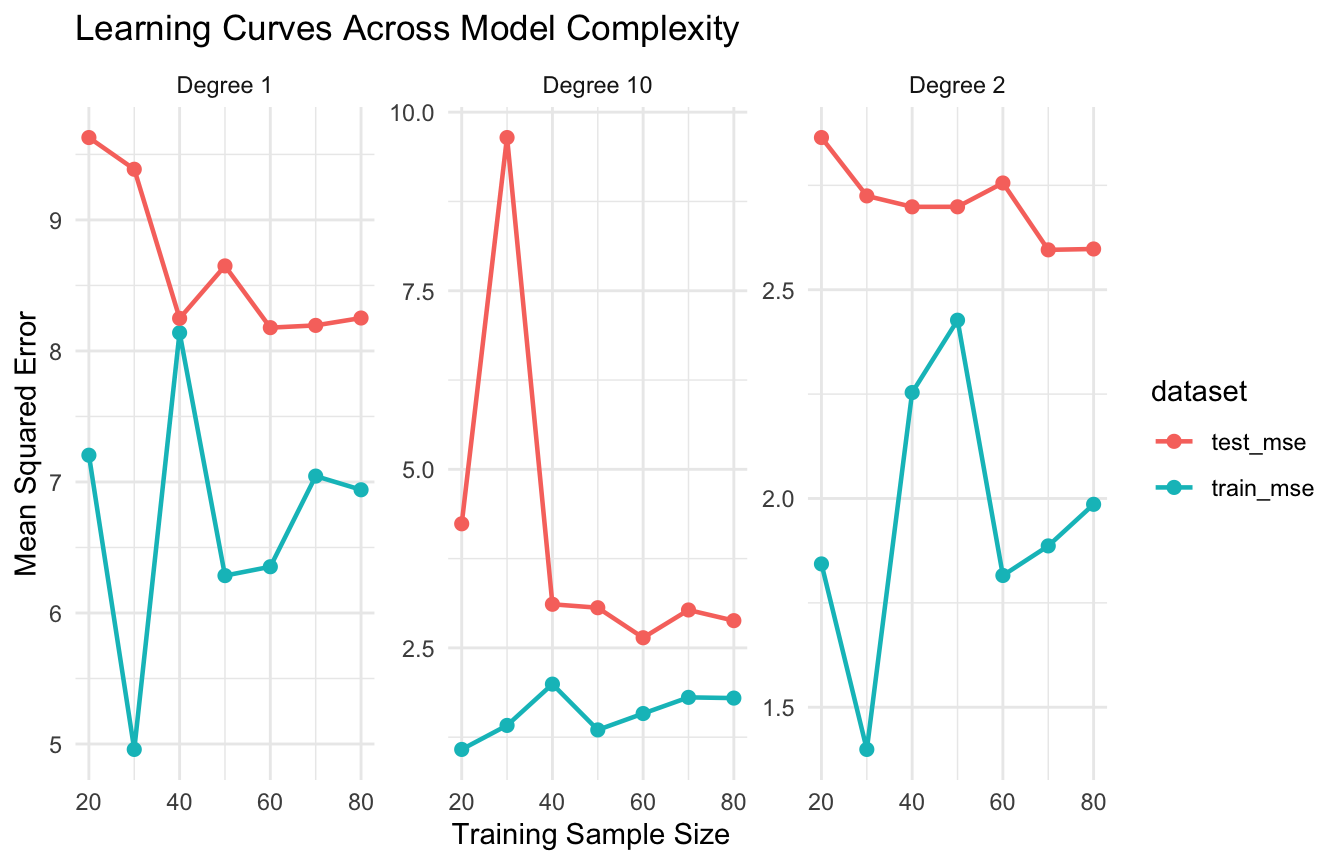
Learning Curves Help Diagnose Underfitting and Overfitting

Another useful diagnostic is the learning curve.

A learning curve examines model performance as the training sample size increases.

This helps answer questions like:

  • is the model underfitting even with lots of data?
  • is the model highly variable and benefiting from more data?
  • is the generalization gap large?

Below is a simple learning-curve style simulation for two models.

learning_curve_fn <- function(deg, train_sizes, full_df, test_df_fixed) {
  purrr::map_dfr(
    train_sizes,
    function(m) {
      idx <- sample(seq_len(nrow(full_df)), size = m)
      train_sub <- full_df[idx, ]
      
      fit <- lm(y ~ poly(x, deg, raw = TRUE), data = train_sub)
      
      train_pred <- predict(fit, newdata = train_sub)
      test_pred  <- predict(fit, newdata = test_df_fixed)
      
      tibble::tibble(
        train_size = m,
        degree = paste0("Degree ", deg),
        train_mse = mse_fun(train_sub$y, train_pred),
        test_mse = mse_fun(test_df_fixed$y, test_pred)
      )
    }
  )
}

train_sizes <- seq(20, 80, by = 10)

lc_df <- dplyr::bind_rows(
  learning_curve_fn(1, train_sizes, train_df, test_df),
  learning_curve_fn(2, train_sizes, train_df, test_df),
  learning_curve_fn(10, train_sizes, train_df, test_df)
)

Plot the learning curves.

lc_long <- lc_df |>
  tidyr::pivot_longer(
    cols = c(train_mse, test_mse),
    names_to = "dataset",
    values_to = "mse"
  )

ggplot2::ggplot(lc_long, ggplot2::aes(x = train_size, y = mse, color = dataset)) +
  ggplot2::geom_line(linewidth = 0.8) +
  ggplot2::geom_point(size = 2) +
  ggplot2::facet_wrap(~ degree, scales = "free_y") +
  ggplot2::labs(
    title = "Learning Curves Across Model Complexity",
    x = "Training Sample Size",
    y = "Mean Squared Error"
  ) +
  ggplot2::theme_minimal()

These curves often reveal:

  • high bias: both train and test error remain high
  • high variance: training error is low, but test error is much higher
  • balanced fit: both curves are lower and closer together

Regularization Is One Practical Response to the Tradeoff

One of the most important AI/ML responses to the bias-variance tradeoff is regularization (Hoerl and Kennard 1970; Tibshirani 1996).

Regularization deliberately constrains a model to reduce variance.

This may increase bias slightly, but if the variance reduction is large enough, total prediction error can improve.

Examples include:

  • ridge regression
  • lasso
  • elastic net
  • early stopping
  • weight decay in neural networks

This is a central lesson in machine learning:

sometimes a slightly biased model predicts better because it is more stable.


Ensemble Methods Also Manage the Tradeoff

Another major response to the bias-variance problem is the use of ensembles.

Ensembles combine multiple models to improve predictive performance.

Different ensemble strategies affect bias and variance differently.

For example:

  • bagging and random forests often reduce variance
  • boosting often reduces bias, though it can also affect variance depending on tuning

This is one reason the bias-variance tradeoff is so important conceptually. It explains not only individual model behavior, but also why major algorithm families work the way they do.


High Bias and High Variance Require Different Fixes

A useful practical lesson is that not all poor performance should be fixed the same way.

If Bias Is High

The model may be too simple. Possible responses include:

  • adding features
  • increasing flexibility
  • allowing nonlinear terms
  • reducing regularization

If Variance Is High

The model may be too unstable. Possible responses include:

  • simplifying the model
  • adding regularization
  • increasing training data
  • using ensembles
  • reducing noise-sensitive predictors

This is why diagnosis matters. You cannot fix the right problem if you misidentify the failure mode.


Bias-Variance Thinking Matters Beyond Polynomial Regression

Polynomial regression is only a teaching device.

The same tradeoff appears in many real models, including:

  • decision trees
  • random forests
  • boosting
  • splines
  • neural networks
  • nearest-neighbor models
  • penalized regressions

The language changes, but the central issue remains:

  • too rigid and you underfit
  • too flexible and you overfit

That is why the bias-variance tradeoff is one of the most portable ideas in modern analytics.


The Tradeoff Also Shapes Baseline Model Strategy

In practice, simpler baseline models are useful not only because they are interpretable, but also because they often have relatively low variance.

A simple model may underfit slightly, but it may still generalize surprisingly well if the signal is modest and the data are noisy.

This is why strong analysts do not begin by assuming that more complexity is automatically better.

The right question is:

does the additional flexibility improve out-of-sample performance enough to justify the added instability?

That is a bias-variance question.


There Is No Universal Best Model Complexity

One of the most important implications of the bias-variance tradeoff is that there is no universally optimal level of complexity.

The right balance depends on:

  • sample size
  • signal-to-noise ratio
  • predictor structure
  • task complexity
  • and the cost of error

A more flexible model may be ideal in a large, information-rich dataset. The same model may be disastrous in a smaller, noisier setting.

This is why model selection must be data- and problem-specific.


Cross-Validation Is One of the Best Practical Tools for Managing the Tradeoff

Because the tradeoff is about generalization, one of the best practical tools for managing it is cross-validation.

Cross-validation helps estimate how a model performs on unseen data.

This makes it useful for:

  • tuning model complexity
  • selecting regularization strength
  • comparing candidate models
  • detecting overfitting

In modern ML workflows, cross-validation is often the operational way the bias-variance tradeoff gets handled.

The principle is statistical. The workflow is computational.


A Practical Checklist for Applied Work

Before choosing or tuning a predictive model, ask:

  • Is the model underfitting or overfitting?
  • How do training and validation error compare?
  • Would more flexibility reduce bias or just increase variance?
  • Would regularization improve stability?
  • Would more data help close the generalization gap?
  • Are learning curves suggesting a persistent problem?
  • Is a simpler baseline already performing competitively?

These questions often improve model choice more than blind complexity escalation.


NoteWhere This Shows Up in AI/ML

Every ML model selection decision in clinical AI is a bias-variance decision: a gradient boosted tree with 500 estimators and deep interaction structure may achieve 0.91 AUC on DoDTR training data and 0.74 on prospective validation, while a regularized logistic regression achieves 0.83 on both — the gap is not noise, it is variance from overfitting to the trauma registry’s site-specific documentation patterns. Trauma mortality models are especially prone to this failure: injury severity scores, mechanism codes, and vitals are documented differently across Level I trauma centers versus far-forward MTFs, so a model trained on one context memorizes institutional artifacts that do not transfer. In deep learning, the double descent phenomenon means that very large models can actually escape the classical bias-variance tradeoff through overparameterization, but this requires massive datasets and careful regularization that are rarely present in military health registry settings. The operationally safe default is to select the simplest model whose out-of-sample performance is competitive, then require prospective validation before deployment.

Closing: Good Models Balance Fit with Stability

The bias-variance tradeoff remains one of the most important ideas in statistics and machine learning because it explains why prediction is not a one-dimensional optimization problem.

A model can fail by being too simple. It can also fail by being too unstable.

That is why good modeling is not about chasing the lowest training error. It is about balancing structure and restraint.

This is the logic behind:

  • regularization
  • ensemble methods
  • cross-validation
  • and thoughtful model selection

The bias-variance tradeoff matters because the best model is usually not the one that fits the hardest, but the one that generalizes with the right balance of flexibility and discipline.


Tip📚 Go Deeper: Prediction Modeling Toolkit

This post is part of the Prediction Modeling Toolkit — a companion reference with learning curve diagnostics, regularization selection templates, and model complexity evaluation scaffolds.

→ Open the Prediction Modeling Toolkit


Series Callout

Note

This post is part of a broader Applied Statistics for AI and Clinical Decision-Making Series:

  • Probability fundamentals for machine learning
  • Random variables and expectation
  • Common probability distributions
  • Central Limit Theorem
  • Law of Large Numbers
  • Sampling methods for Biostats and ML
  • Hypothesis testing in the age of AI
  • Confidence intervals
  • Maximum likelihood estimation
  • Bayesian inference
  • Linear regression
  • Logistic regression
  • Generalized linear models
  • Analysis of variance
  • Principal component analysis
  • Cluster analysis
  • Time series analysis
  • Survival analysis
  • Non-parametric methods
  • Bias-variance tradeoff
  • Regularization
  • Cross-validation
  • Information theory
  • Optimization techniques
  • Linear algebra basics
  • Calculus for ML
  • Monte Carlo methods
  • Dimensionality curse and reduction techniques
  • Model evaluation metrics
  • Ensemble methods

References

Domingos, Pedro. 2000. “A Unified Bias-Variance Decomposition for Zero-One and Squared Loss.” Proceedings of the Seventeenth National Conference on Artificial Intelligence, 564–69.
Hastie, Trevor, Robert Tibshirani, and Jerome Friedman. 2009. The Elements of Statistical Learning: Data Mining, Inference, and Prediction. 2nd ed. Springer.
Hoerl, Arthur E., and Robert W. Kennard. 1970. “Ridge Regression: Biased Estimation for Nonorthogonal Problems.” Technometrics 12 (1): 55–67.
James, Gareth, Daniela Witten, Trevor Hastie, and Robert Tibshirani. 2021. An Introduction to Statistical Learning: With Applications in R. 2nd ed. Springer.
Tibshirani, Robert. 1996. “Regression Shrinkage and Selection via the Lasso.” Journal of the Royal Statistical Society: Series B 58 (1): 267–88.