Entropy in Stats: Measuring Uncertainty for Smarter AI
Applied Statistics
AI and Clinical Decision-Making
An applied introduction to entropy, mutual information, KL divergence, and information-theoretic ideas that support modern statistics and AI.
Published
January 15, 2025
Modified
June 9, 2026
Executive Summary
Information theory gives us a formal language for uncertainty.
It asks questions like:
how uncertain is a variable?
how much information does one variable provide about another?
how inefficient is one probability model relative to another?
and how can uncertainty be encoded, compressed, or reduced?
These ideas matter deeply in both statistics and machine learning.
In classical statistics, information-theoretic ideas help quantify uncertainty and compare probability models (Shannon 1948; Cover and Thomas 2006). In AI/ML, they sit underneath:
decision tree splitting,
feature selection,
cross-entropy loss,
variational autoencoders,
and many generative modeling workflows.
This post introduces:
entropy,
conditional entropy,
mutual information,
Kullback-Leibler divergence,
and how these ideas connect to prediction, compression, and feature relevance.
Information theory matters because learning is fundamentally about reducing uncertainty, and entropy gives us a way to measure how much uncertainty is left.
Information Theory Is About Quantifying Uncertainty
At a high level, information theory gives us tools for measuring how uncertain a random variable is and how much that uncertainty changes when we observe something else.
This is useful because many statistical and ML tasks are really uncertainty problems in disguise.
For example:
a classifier tries to reduce uncertainty about a label
a feature selector asks which variable is most informative
a compressor asks how efficiently data can be encoded
a generative model asks how closely one distribution approximates another
Information theory provides a common language for all of these.
That is one reason it remains so central across fields that otherwise look quite different.
Entropy Measures Uncertainty in a Distribution
The most fundamental quantity in information theory is entropy.
For a discrete random variable (X) with probabilities (p(x)), entropy is:
\[
H(X) = -\sum_x p(x)\log p(x)
\] Entropy is high when the outcome is very uncertain. Entropy is low when the outcome is predictable.
For example:
a fair coin has higher entropy than a coin that lands heads 99% of the time
a uniformly distributed categorical variable has higher entropy than one dominated by a single class
This is why entropy is often described as a measure of uncertainty, unpredictability, or information content.
Entropy Is Highest When Outcomes Are Most Evenly Distributed
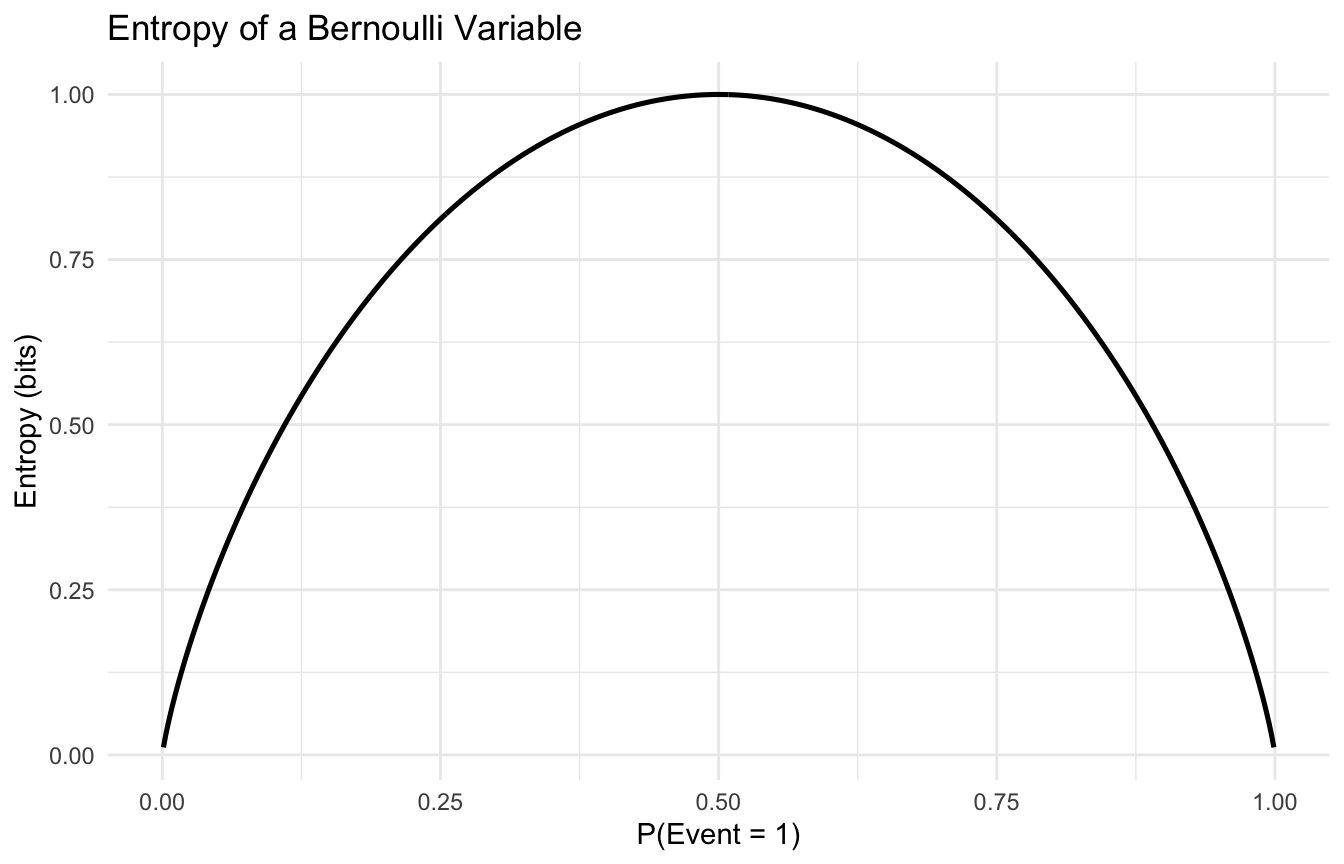
One of the most useful intuitions is that entropy is maximized when probability mass is spread evenly across possible outcomes.
If one category dominates, uncertainty is lower.
This is easy to see with a simple Bernoulli example.
Entropy tells us how uncertain a variable is on its own.
But often the more interesting question is:
how uncertain is the outcome after we observe another variable?
That is the idea of conditional entropy:
\[
H(Y \mid X)
\] This measures how much uncertainty remains in (Y) once (X) is known.
If knowing (X) makes (Y) nearly predictable, then the conditional entropy is low. If knowing (X) changes very little, then the conditional entropy remains high.
This quantity is central to feature usefulness.
A good predictor reduces uncertainty about the target.
Mutual Information Measures How Informative One Variable Is About Another
A key information-theoretic quantity for applied work is mutual information.
Mutual information between (X) and (Y) is:
\[
I(X;Y) = H(Y) - H(Y \mid X)
\] It can also be written symmetrically as:
\[
I(X;Y) = H(X) + H(Y) - H(X,Y)
\] This tells us how much knowing one variable reduces uncertainty about the other.
Properties:
it is always nonnegative
it equals zero if the variables are independent
larger values mean stronger information-sharing
This makes mutual information especially useful for feature selection and exploratory variable ranking.
A Feature Selection Example with Mutual Information
Suppose we have a binary outcome and two candidate predictors.
One predictor is informative. The other is mostly noise.
The informative feature should show higher mutual information because it reduces uncertainty about the event more strongly.
Mutual Information Can Detect Nonlinear Dependence Better Than Correlation
One of the reasons mutual information is so useful is that it is not limited to linear association.
Correlation is excellent for linear relationships, but it can miss nonlinear dependence.
Mutual information is more general. If two variables share information, mutual information can detect that even when the relationship is not linear in a simple correlation sense.
That is one reason information-theoretic feature selection is often attractive in machine learning pipelines.
It can sometimes identify useful predictors that a purely linear screening approach might understate.
Decision Trees Use Entropy to Split Data
One of the clearest machine learning applications of entropy is in decision trees.
In tree algorithms like ID3, the goal is to split the data so that child nodes are more homogeneous in the target than the parent node (Cover and Thomas 2006; Hastie et al. 2009).
This is measured through information gain:
\[
\text{Information Gain} = H(Y) - H(Y \mid X)
\] That is exactly mutual information between the splitting feature and the target.
So when a tree selects a split that maximally reduces entropy, it is directly applying an information-theoretic criterion.
This is one of the reasons information theory matters so much in ML: the ideas are not abstract decorations. They actively shape model construction.
KL Divergence Measures How Different Two Distributions Are
Kullback-Leibler divergence formalizes the information lost when one probability distribution is used to approximate another (Kullback and Leibler 1951).
Another major quantity in information theory is Kullback-Leibler divergence, or KL divergence.
For two discrete distributions (P) and (Q):
\[
D_{KL}(P \parallel Q) = \sum_x P(x)\log\left(\frac{P(x)}{Q(x)}\right)
\] KL divergence is often interpreted as a measure of how inefficient it is to use distribution (Q) to approximate data actually generated from (P).
Important cautions:
it is not symmetric
it is not a true distance metric
it is always nonnegative when well-defined
But it is extremely useful for comparing probabilistic models.
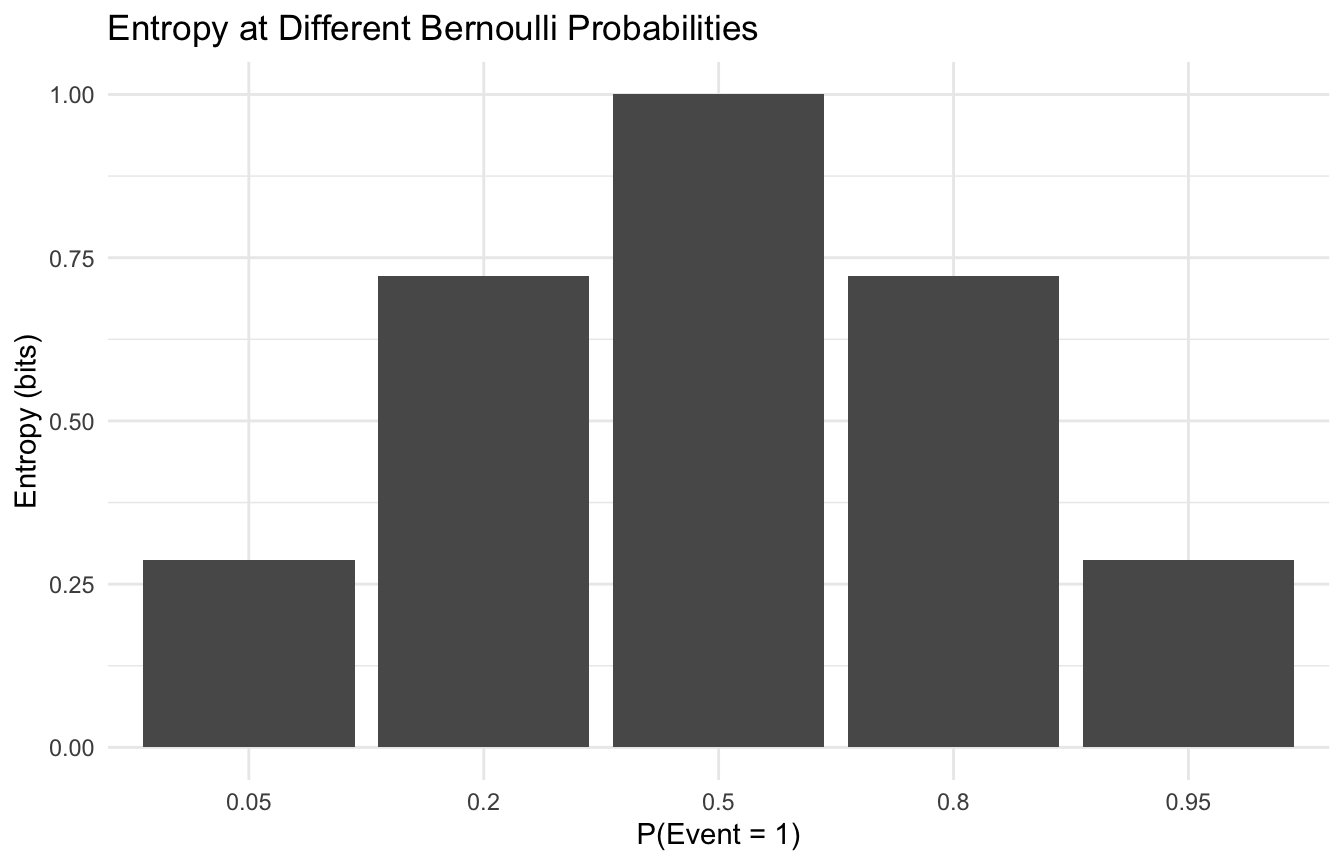
A Small KL Divergence Example Makes the Idea Concrete
This helps reinforce that uncertainty is highest near balanced probabilities and lower near near-certain outcomes.
Information-Theoretic Feature Selection Is Useful, but Not Sufficient Alone
Mutual information can be a powerful feature-screening tool, but it should not be treated as the whole modeling story.
A feature may have:
low marginal mutual information but strong joint value with other features
high mutual information but unstable measurement
or strong association that is operationally irrelevant
So information-theoretic ranking is often useful for:
screening
exploration
and variable prioritization
But it should still be embedded within a broader modeling and validation strategy.
This is especially important in high-dimensional applied work.
Information Theory Connects Statistics, ML, and Computation
One reason information theory is so powerful is that it naturally links several domains.
It speaks simultaneously to:
probability distributions
uncertainty
coding and compression
feature relevance
predictive loss
and model mismatch
This makes it one of the most conceptually unifying topics in modern analytics.
A statistician may encounter entropy through uncertainty. A machine learning practitioner may encounter it through cross-entropy loss. A computer scientist may encounter it through compression.
The underlying logic is the same.
A Practical Checklist for Applied Work
Before using information-theoretic tools, ask:
Am I measuring uncertainty, dependence, or model mismatch?
Is entropy the right summary for the problem?
Is mutual information being estimated in a way appropriate to the variable type?
Would correlation miss important nonlinear structure here?
Is KL divergence being interpreted as a directional comparison, not a distance?
Am I using information-theoretic screening as a first step rather than the only step?
Does the ML loss function I am using have an information-theoretic meaning worth understanding?
These questions usually improve both interpretation and application.
NoteWhere This Shows Up in AI/ML
Every neural network trained for clinical prediction — sepsis onset, deterioration, 30-day readmission — minimizes cross-entropy loss during training, which is the direct information-theoretic measure of how far the model’s predicted probability distribution is from the true label distribution. KL divergence is used in production ML monitoring pipelines to detect distribution shift: when the KL divergence between the feature distribution at training time and the feature distribution at inference time exceeds a threshold, the model is flagged for recalibration — a process directly applicable to DoDTR-based models redeployed across different operational theaters. When cross-entropy is replaced with a surrogate loss without understanding its information-theoretic meaning, or when KL-based drift detection is skipped, models silently degrade against populations they were never shown.
Closing: Information Theory Gives Analytics a Language for Uncertainty
Information theory remains one of the most important conceptual bridges in modern analytics because it gives us a way to measure uncertainty, relevance, and model mismatch with precision.
Entropy quantifies unpredictability. Mutual information tells us how much uncertainty one variable removes from another. KL divergence measures how costly it is to approximate one distribution with another.
These are not merely elegant formulas (Cover and Thomas 2006). They are active ingredients in feature selection, decision trees, generative modeling, compression, and modern AI loss functions.
Information theory matters because learning is, at its core, the process of turning uncertainty into structure, and entropy tells us how much uncertainty we started with.
This post is part of the Prediction Modeling Toolkit — a companion reference with entropy-based feature selection templates, mutual information code, and cross-entropy loss scaffolds for classification models.
Cover, Thomas M., and Joy A. Thomas. 2006. Elements of Information Theory. 2nd ed. Wiley-Interscience.
Hastie, Trevor, Robert Tibshirani, and Jerome Friedman. 2009. The Elements of Statistical Learning: Data Mining, Inference, and Prediction. 2nd ed. Springer.
Kullback, Solomon, and Richard A. Leibler. 1951. On Information and Sufficiency. 22 (1): 79–86.
Shannon, Claude E. 1948. “A Mathematical Theory of Communication.”Bell System Technical Journal 27 (3): 379–423.