n <- 300
df_pca <- tibble(
  sbp      = rnorm(n,110,20),
  hr       = rnorm(n,95,18),
  rr       = rnorm(n,18,4),
  gcs      = rnorm(n,13,3),
  lactate  = rexp(n, 0.5) + 1,
  spo2     = rnorm(n,96,3)
)
pca_fit <- prcomp(df_pca, scale.=TRUE)
pca_df  <- as_tibble(pca_fit$x[,1:2]) |>
  mutate(severity = df_pca$lactate > 4)

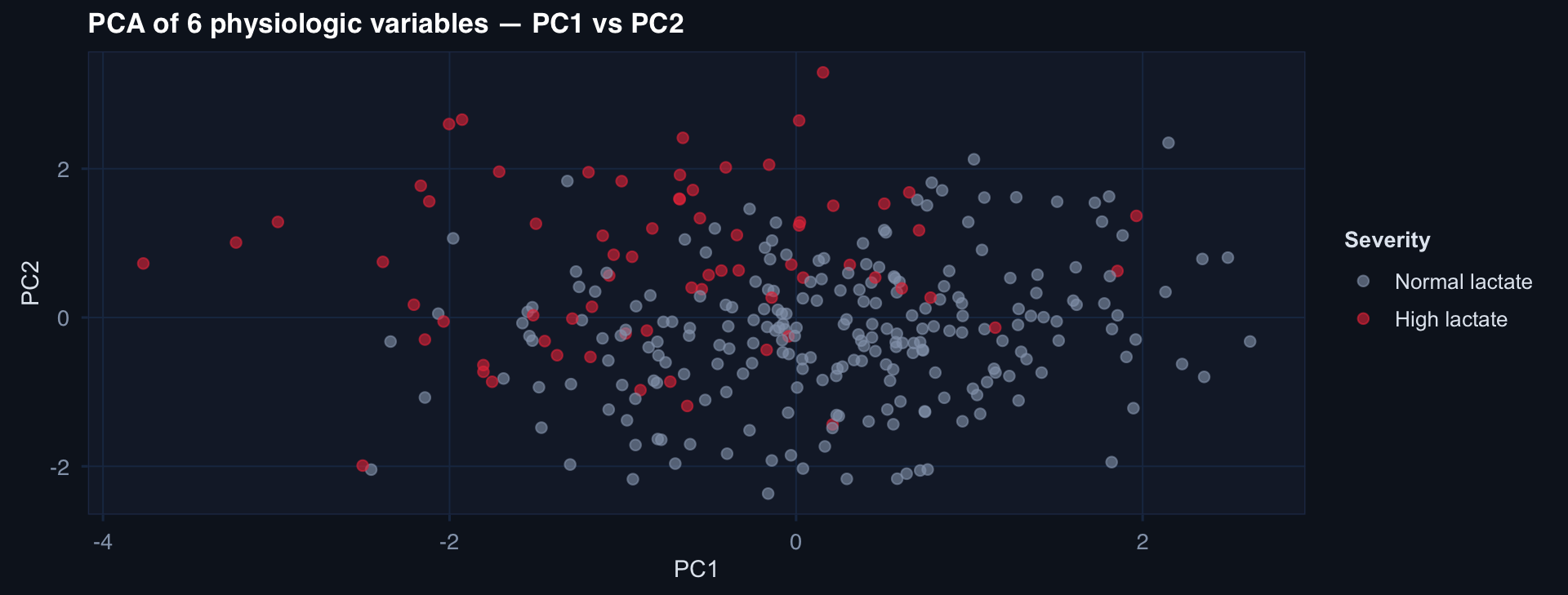
ggplot(pca_df, aes(PC1, PC2, color=severity)) +
  geom_point(alpha=0.6) +
  scale_color_manual(values=c("FALSE"="#94a3b8","TRUE"="#e63946"),
                     labels=c("Normal lactate","High lactate")) +
  labs(title="PCA of 6 physiologic variables — PC1 vs PC2",
color="Severity") + theme_di()Dimensionality Reduction & Clustering
Applied Statistics for AI & Clinical Decision-Making — Lecture 7 of 10
2026-01-01
PCA in R: Registry Example
Scree Plot: How Many Components?
var_explained <- pca_fit$sdev^2 / sum(pca_fit$sdev^2)
tibble(PC = paste0("PC",1:6), pct = var_explained * 100) |>
  ggplot(aes(x=PC, y=pct, group=1)) +
  geom_col(fill="#2563eb", alpha=0.8) +
  geom_line(linewidth=1, color="#1b2e4b") +
  geom_point(size=3, color="#1b2e4b") +
  labs(title="Scree plot: variance explained by each PC",
       x="Principal Component", y="% Variance Explained") + theme_di()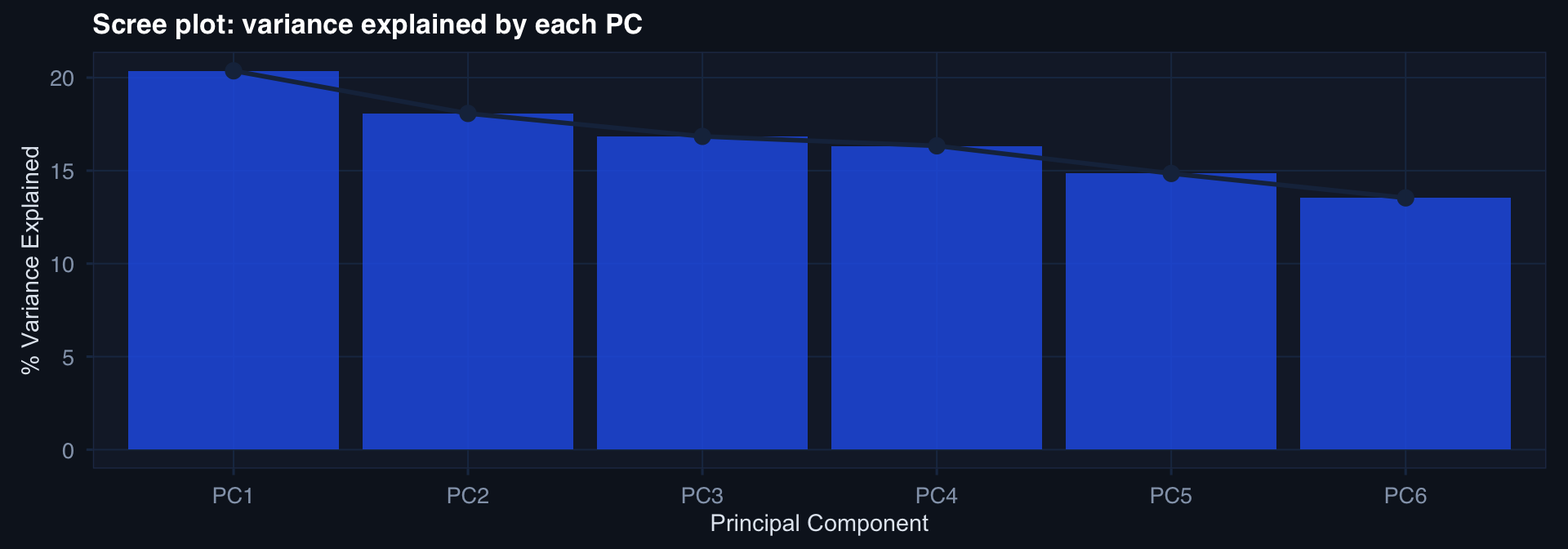
Practical rule: retain PCs until you explain ~80% of variance, or where the scree “elbows.”
k-Means: Partitioning by Centroid Distance
Minimize: \(\sum_{k=1}^K \sum_{i \in C_k} \| x_i - \mu_k \|^2\)
km <- kmeans(df_pca, centers=3, nstart=20)
df_pca |>
  mutate(cluster = factor(km$cluster)) |>
  ggplot(aes(sbp, lactate, color=cluster)) +
  geom_point(alpha=0.6) +
  scale_color_manual(values=c("#2563eb","#e63946","#0891b2")) +
  labs(title="k-means clustering: 3 injury phenotype groups",
       x="SBP", y="Lactate") + theme_di()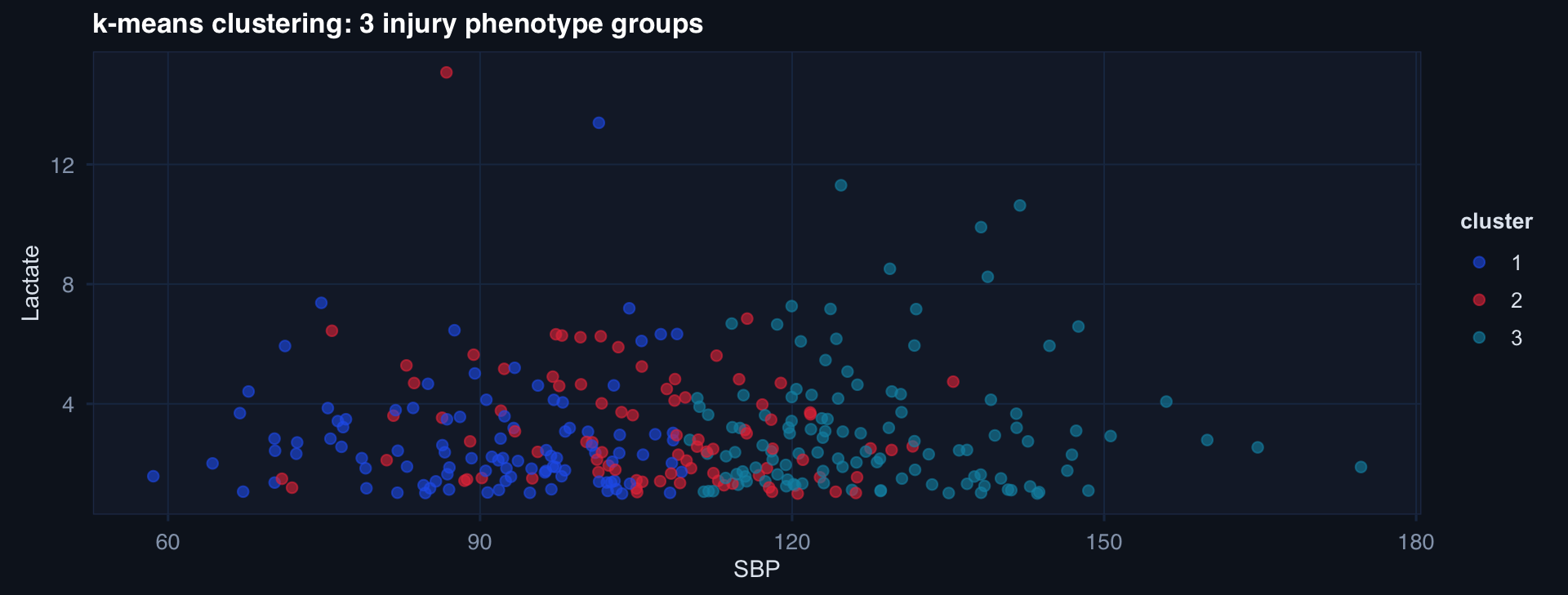
Trauma phenotyping clusters might correspond to: compensated shock (normal SBP, mild lactate elevation), uncompensated shock (low SBP, high lactate), neurological dominant injury (normal physiology, low GCS).
Choosing k: The Elbow and Silhouette
wss <- sapply(1:8, function(k) kmeans(df_pca, k, nstart=10)$tot.withinss)
tibble(k=1:8, wss=wss) |>
  ggplot(aes(k, wss)) +
  geom_line(linewidth=1.2, color="#2563eb") +
  geom_point(size=3, color="#1b2e4b") +
  geom_vline(xintercept=3, linetype=2, color="#e63946") +
  labs(title="Elbow method: within-cluster sum of squares vs. k",
       x="Number of clusters k", y="Total WSS") + theme_di()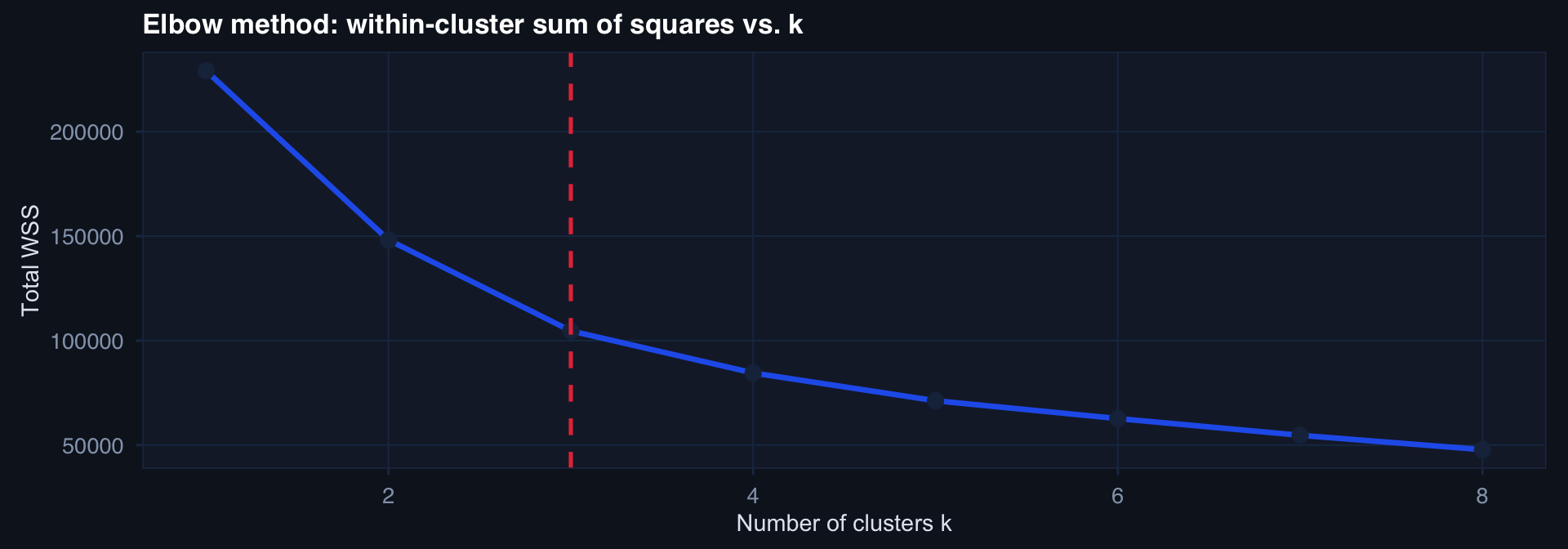
The “elbow” where WSS stops decreasing sharply suggests k=3. Validate clinically — do the clusters correspond to meaningful patient phenotypes?
Distance Breaks Down in High Dimensions
set.seed(42)
compute_dist_ratio <- function(p, n=100) {
  X <- matrix(runif(n*p), n, p)
  dists <- as.vector(dist(X))
  max(dists) / min(dists)
}

dims <- c(1,2,5,10,50,100,200,500)
ratios <- sapply(dims, compute_dist_ratio)

tibble(p=dims, ratio=ratios) |>
  ggplot(aes(p, ratio)) +
  geom_line(linewidth=1.2, color="#2563eb") +
  geom_point(size=3, color="#1b2e4b") +
  scale_x_log10() +
  labs(title="Max/min distance ratio approaches 1 as dimensions grow",
       x="Dimensions (log scale)", y="max dist / min dist") + theme_di()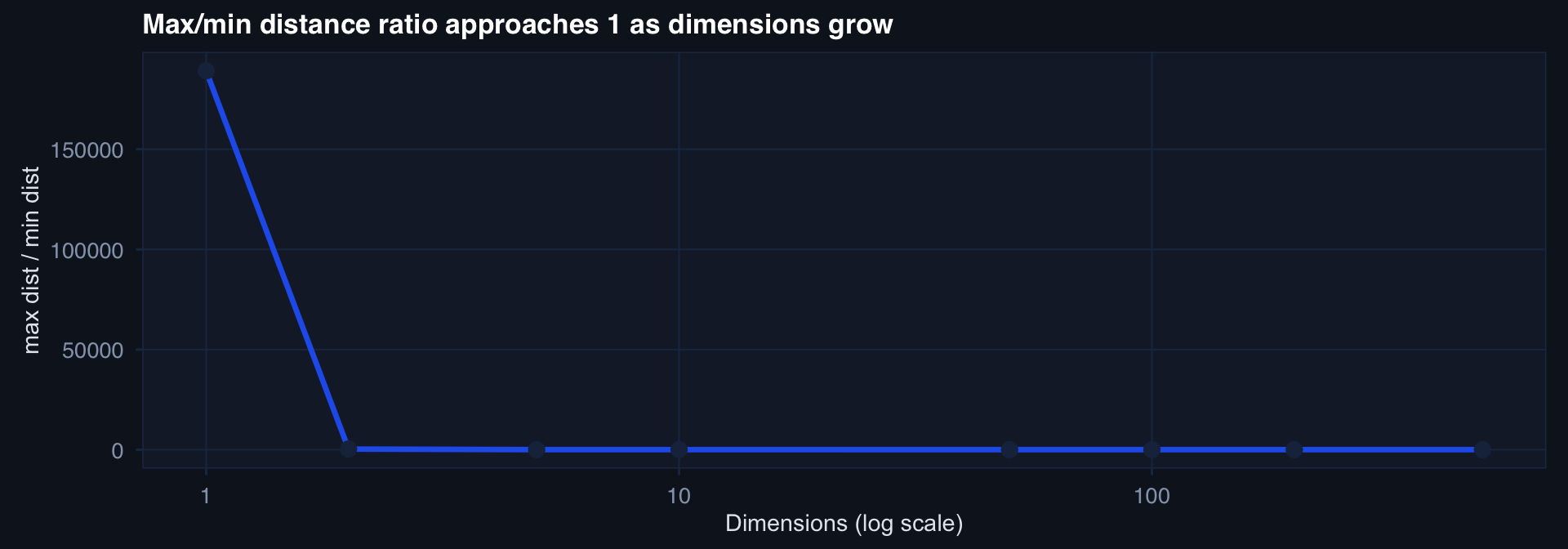
When max ≈ min distance: kNN, clustering, and distance-based models lose meaning. Every point is equidistant from every other point.