Inference — Estimating and Testing from Data

Applied Statistics for AI & Clinical Decision-Making — Lecture 3 of 10

Jonathan D. Stallings, PhD, MS

Data InDeed | dataindeed.org

2026-01-01

A p-value does not tell you what you think it tells you.

What You’ll Learn Today

Post 7 Beyond p < 0.05

  • What a p-value actually is
  • Type I & II errors
  • Effect size > significance

Post 8 Confidence Intervals

  • Correct interpretation
  • Width, precision, n
  • Why CIs beat p-values

Post 9 Maximum Likelihood

  • The logic of MLE
  • Score equations
  • MLE unifies most models

Part 1

Beyond p < 0.05

Hypothesis testing in the age of AI

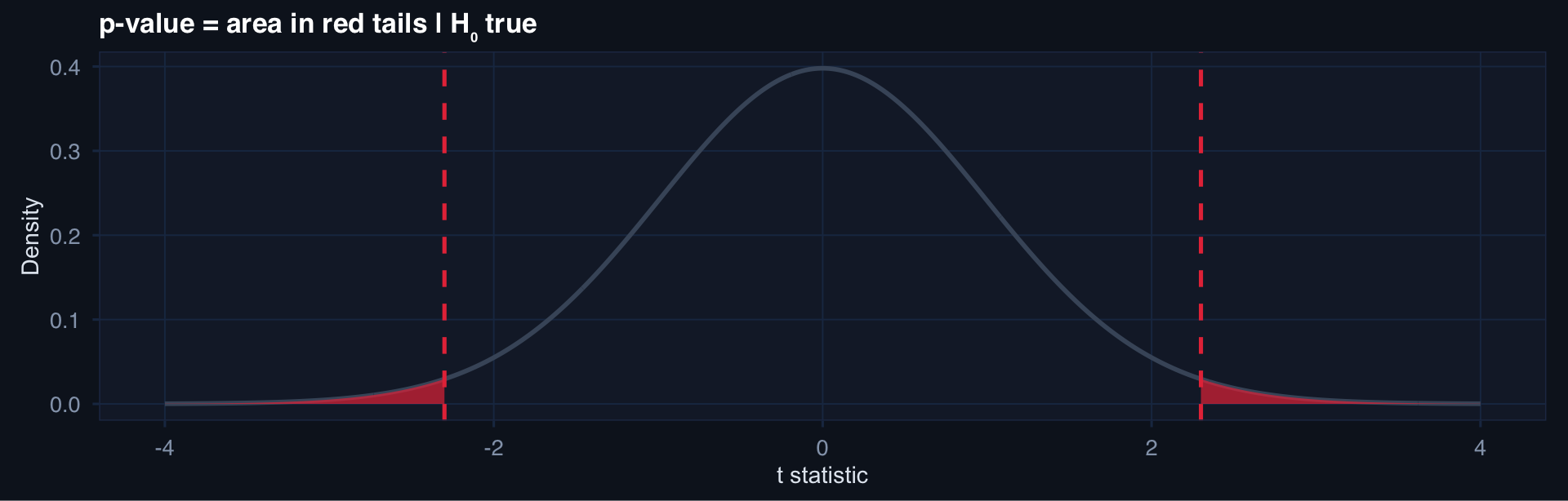
What a p-value Actually Is

p-value = P(observing data this extreme or more | H₀ is true)

What it is NOT:

  • P(H₀ is true)
  • P(you made a mistake)
  • A measure of effect size
  • A measure of clinical importance
null_df <- tibble::tibble(t = seq(-4, 4, 0.01), y = dt(t, df = 98))
obs_t <- 2.3
ggplot2::ggplot(null_df, aes(t, y)) +
  geom_line(linewidth = 1, color = "#475569") +
  geom_area(data = filter(null_df, t >= obs_t), fill = "#e63946", alpha = 0.7) +
  geom_area(data = filter(null_df, t <= -obs_t), fill = "#e63946", alpha = 0.7) +
  geom_vline(xintercept = c(-obs_t, obs_t), linetype = 2) +
  labs(title = "p-value = area in red tails | H₀ true", x = "t statistic", y = "Density") + theme_di()

Type I and Type II Errors

H₀ True H₀ False
Reject H₀ Type I error (α) ✅ Correct (Power = 1-β)
Fail to reject ✅ Correct Type II error (β)

In clinical AI the asymmetry matters:

Trauma triage model:

  • Type I error = flag patient who doesn’t need intervention → wasted resources
  • Type II error = miss patient who does need intervention → preventable death

The cost of these errors is not symmetric. Setting α = 0.05 arbitrarily ignores this.

Effect Size: What Significance Ignores

Statistical significance ≠ clinical significance

set.seed(42)
n_large <- 5000; n_small <- 50
df_large <- tibble(group = rep(c("A","B"), each=n_large),
                   y = c(rnorm(n_large,0,1), rnorm(n_large,0.05,1)))
df_small <- tibble(group = rep(c("A","B"), each=n_small),
                   y = c(rnorm(n_small,0,1), rnorm(n_small,0.8,1)))

p_large <- t.test(y~group, data=df_large)$p.value
p_small <- t.test(y~group, data=df_small)$p.value

tibble::tibble(
  Dataset = c("n=5000/group, d=0.05", "n=50/group, d=0.80"),
  `p-value` = round(c(p_large, p_small), 4),
  `Effect size (d)` = c(0.05, 0.80),
  `Clinical importance` = c("Negligible", "Large")
)
# A tibble: 2 × 4
  Dataset              `p-value` `Effect size (d)` `Clinical importance`
  <chr>                    <dbl>             <dbl> <chr>                
1 n=5000/group, d=0.05    0.0053              0.05 Negligible           
2 n=50/group, d=0.80      0                   0.8  Large                

Lesson: Large n detects trivially small effects. Small n misses large ones.

Part 2

Confidence Intervals

The honest way to report estimation uncertainty

What a Confidence Interval Actually Means

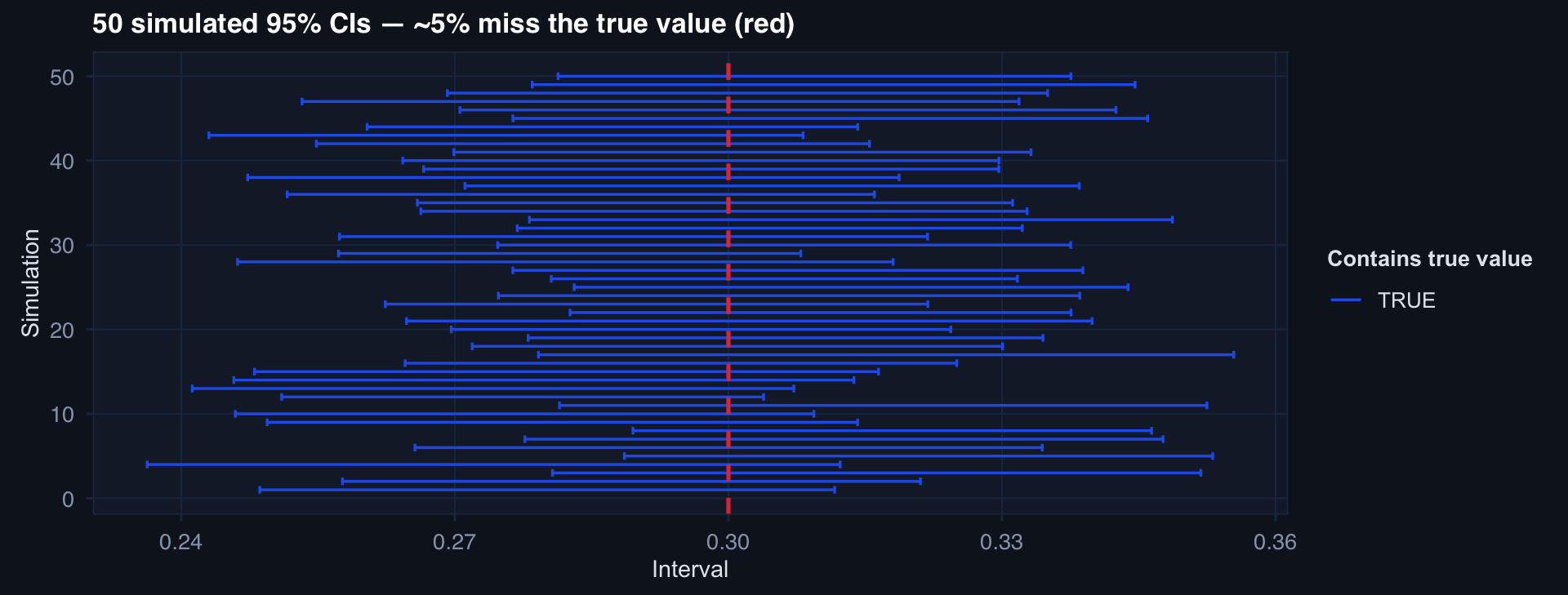
A 95% CI means: if we repeated this study 100 times, approximately 95 of the resulting intervals would contain the true parameter.

It does NOT mean: “there is a 95% probability the true value is in this interval”

simulate_ci <- function(id) {
  x <- rnorm(40, mean=0.30, sd=0.10)
  ci <- t.test(x)$conf.int
  tibble(id=id, lower=ci[1], upper=ci[2], contains_true = ci[1] <= 0.30 & ci[2] >= 0.30)
}
ci_df <- purrr::map_dfr(1:50, simulate_ci)
ggplot2::ggplot(ci_df, aes(x=id, ymin=lower, ymax=upper, color=contains_true)) +
  geom_errorbar(linewidth=0.6) +
  geom_hline(yintercept=0.30, linetype=2, color="#e63946") +
  scale_color_manual(values=c("FALSE"="#e63946","TRUE"="#2563eb")) +
  coord_flip() + theme_di() +
  labs(title="50 simulated 95% CIs — ~5% miss the true value (red)",
       x="Simulation", y="Interval", color="Contains true value")
CI Width Tells You About Precision

ci_widths <- tibble::tibble(
  n = c(20, 50, 100, 200, 500, 1000),
  width = 2 * qt(0.975, df = n-1) * (0.15 / sqrt(n))
)
ggplot2::ggplot(ci_widths, aes(x=n, y=width)) +
  geom_line(linewidth=1.2, color="#2563eb") +
  geom_point(size=3, color="#1b2e4b") +
  labs(title="95% CI width vs. sample size (σ = 0.15)",
       x="n", y="CI width (percentage points)") + theme_di()
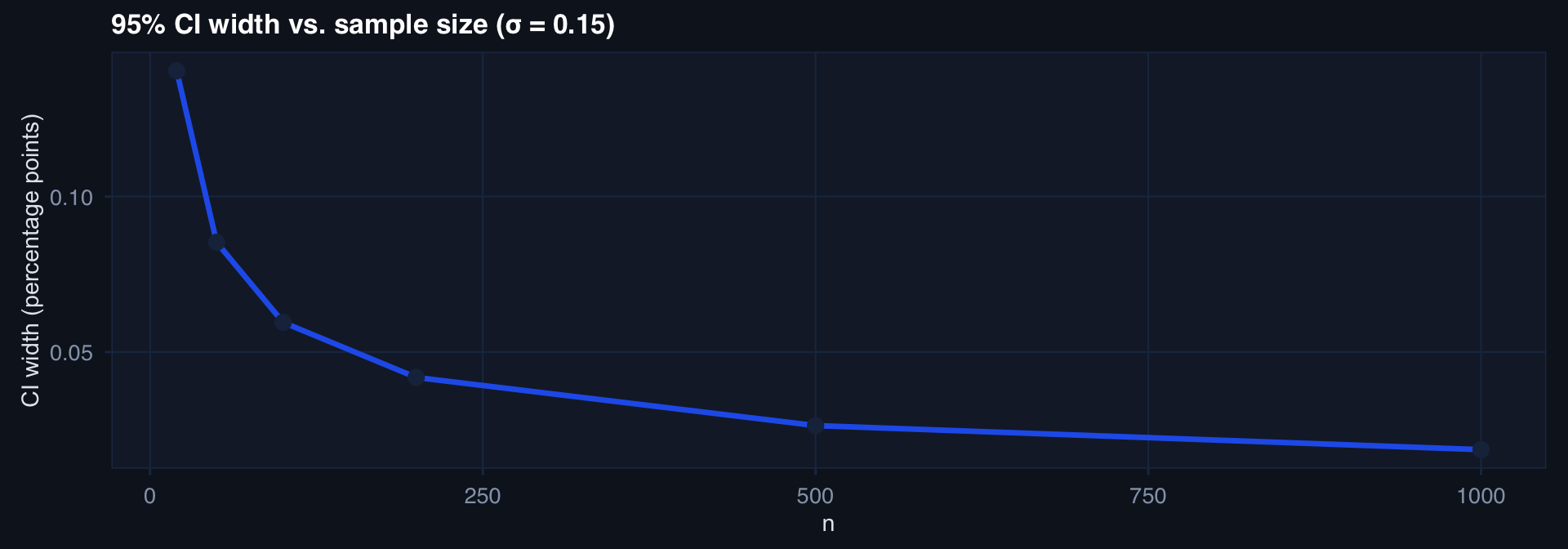
Registry reporting: A 95% CI of [0.23, 0.41] for a CPG compliance rate tells commanders the range of plausible true compliance — far more actionable than “p = 0.003.”

Part 3

Maximum Likelihood Estimation

The unifying framework behind most models

The Intuition Behind MLE

Find the parameter values that make the observed data most probable.

\[\hat{\theta}_{MLE} = \arg\max_\theta \; \mathcal{L}(\theta \mid \text{data}) = \arg\max_\theta \prod_{i=1}^n f(x_i \mid \theta)\]

In practice: maximize the log-likelihood \(\ell(\theta) = \sum_i \log f(x_i \mid \theta)\)

Why it matters:

  • Logistic regression → maximizes Bernoulli log-likelihood
  • Linear regression → MLE = OLS when errors are Normal
  • Poisson regression → maximizes Poisson log-likelihood
  • Survival models → maximizes partial likelihood

MLE is the engine underneath almost every model in this series.

MLE in Action: Fitting a Bernoulli Model

# Trauma mortality: find MLE of p from n=50 patients, 12 deaths
n_patients <- 50; n_deaths <- 12

# Log-likelihood surface
p_grid <- seq(0.01, 0.99, 0.001)
log_lik <- dbinom(n_deaths, size=n_patients, prob=p_grid, log=TRUE)

mle_p <- p_grid[which.max(log_lik)]

tibble::tibble(p = p_grid, log_lik = log_lik) |>
  ggplot2::ggplot(aes(p, log_lik)) +
  geom_line(linewidth=1.2, color="#2563eb") +
  geom_vline(xintercept=mle_p, linetype=2, color="#e63946") +
  annotate("text", x=mle_p+0.06, y=-25,
           label=paste0("MLE = ", mle_p), color="#e63946") +
  labs(title="Log-likelihood for mortality rate p",
       x="p (mortality rate)", y="Log-likelihood") + theme_di()
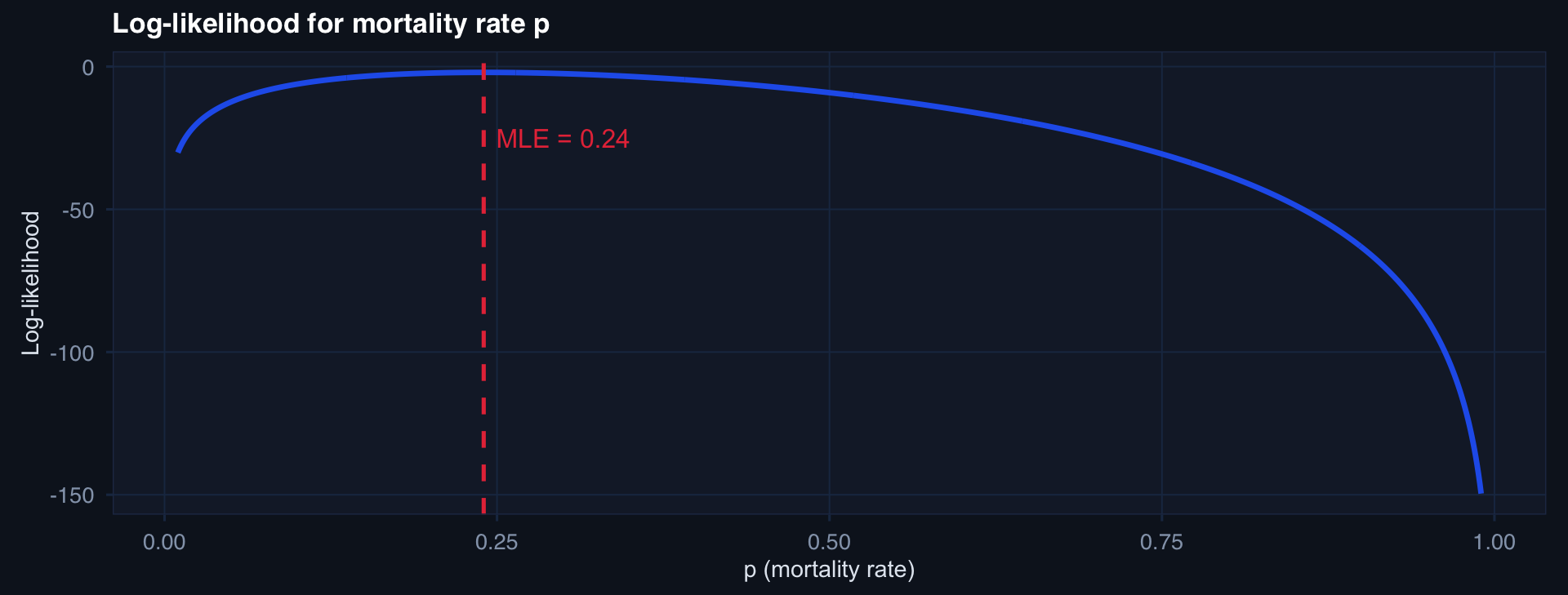
MLE = 12/50 = 0.24 — exactly the sample proportion. The math confirms the intuition.

Lecture 3 — Key Takeaways

Hypothesis Testing

  • p-value = P(data | H₀) — not P(H₀ | data)
  • Type I/II error tradeoffs are asymmetric in clinical settings
  • Effect size always alongside p-value
  • Significance thresholds should reflect error costs

Confidence Intervals

  • Frequentist procedure — not a probability statement about one interval
  • Width = precision = function of n and σ
  • Report CIs instead of (or alongside) p-values

MLE

  • Find θ that maximizes P(observed data | θ)
  • Maximize log-likelihood in practice
  • Unifies linear, logistic, Poisson, survival models
  • OLS = MLE when residuals are Normal

The meta-lesson: Inference is about characterizing uncertainty honestly — not just getting below 0.05.

Coming Up: Lecture 4

Bayesian Methods & Simulation

The frequentist framework asks: what is P(data | parameter)? The Bayesian framework asks: what is P(parameter | data)?

Posts 10, 27, 23:

  • Bayesian Thinking — priors, likelihoods, posteriors
  • Monte Carlo — simulating when math is intractable
  • Entropy — information, uncertainty, KL divergence