Bayesian Methods & Simulation

Applied Statistics for AI & Clinical Decision-Making — Lecture 4 of 10

Jonathan D. Stallings, PhD, MS

Data InDeed | dataindeed.org

2026-01-01

Bayesian inference is not a philosophy. It is a computational framework.

What You’ll Learn Today

Post 10 Bayesian Thinking

  • Priors, likelihoods, posteriors
  • Conjugate updates
  • Posterior predictive distributions

Post 27 Monte Carlo Methods

  • Monte Carlo integration
  • Importance sampling
  • MCMC & Metropolis-Hastings

Post 23 Entropy & Information

  • Shannon entropy
  • KL divergence
  • Information in model selection

Part 1

Bayesian Thinking

Updating belief with evidence

The Bayesian Framework

\[\underbrace{P(\theta \mid y)}_{\text{posterior}} \propto \underbrace{P(y \mid \theta)}_{\text{likelihood}} \times \underbrace{P(\theta)}_{\text{prior}}\]

Three components:

  • Prior \(P(\theta)\) — what you believe before seeing data
  • Likelihood \(P(y|\theta)\) — how probable is the data given the parameter
  • Posterior \(P(\theta|y)\) — updated belief after seeing data

The Bayesian advantage in small samples:

When registry data is sparse (rare injury, small cohort), a sensible prior prevents the model from overfitting to noise.

CPG compliance example:

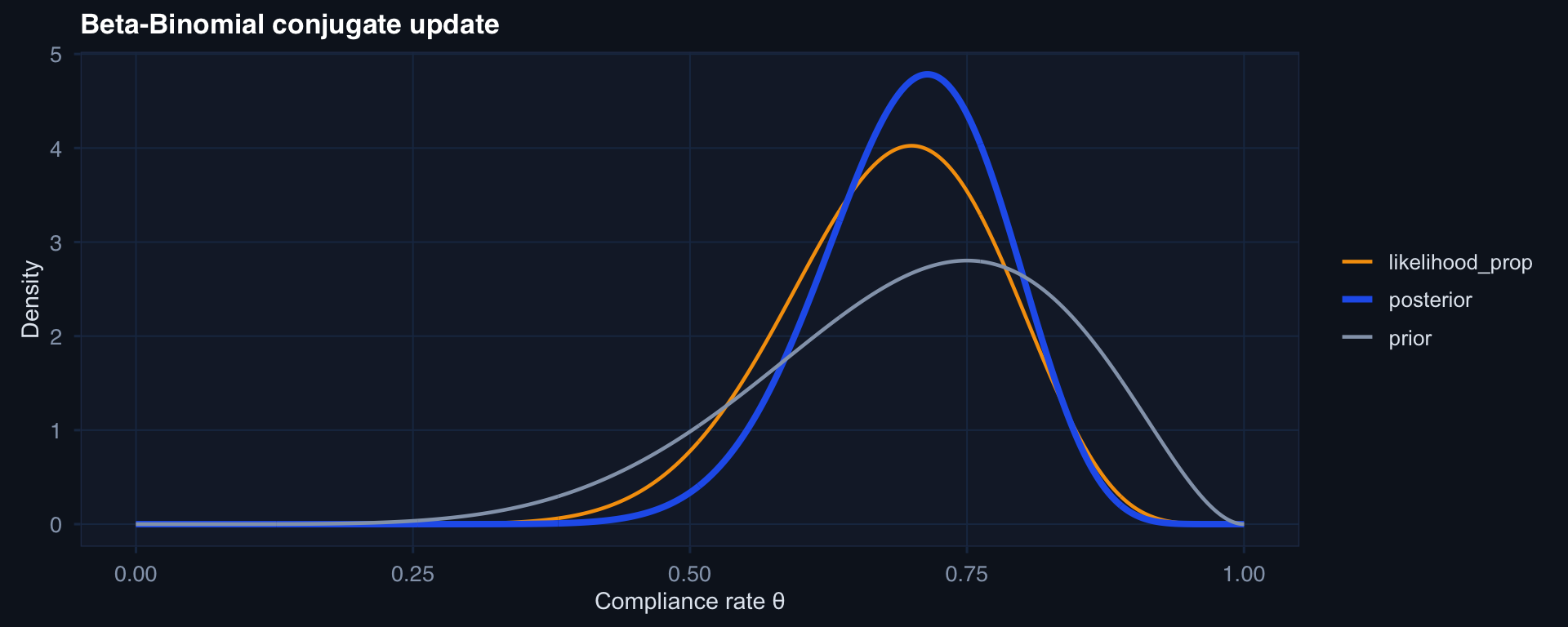
Prior: historical compliance ~70% based on previous quarter.

New data: 14/20 cases compliant this quarter.

Posterior: updated estimate that appropriately shrinks toward the prior when n is small.

Conjugate Updating: Beta-Binomial

# Prior: Beta(7, 3) → prior belief ~70% compliance
# Data: 14/20 compliant
# Posterior: Beta(7+14, 3+6) = Beta(21, 9)

theta <- seq(0, 1, 0.001)
prior     <- dbeta(theta, 7, 3)
likelihood_prop <- dbeta(theta, 15, 7)   # normalized for display
posterior <- dbeta(theta, 21, 9)

tibble(theta, prior, likelihood_prop, posterior) |>
  tidyr::pivot_longer(-theta) |>
  ggplot(aes(theta, value, color=name, linewidth=name)) +
  geom_line() +
  scale_color_manual(values=c("prior"="#94a3b8","likelihood_prop"="#f59e0b","posterior"="#2563eb")) +
  scale_linewidth_manual(values=c("prior"=0.8,"likelihood_prop"=0.8,"posterior"=1.4)) +
  labs(title="Beta-Binomial conjugate update",
       x="Compliance rate θ", y="Density", color=NULL, linewidth=NULL) + theme_di()

Posterior Predictive Distribution

# Posterior Beta(21,9) — predict next 20 patients
n_sims <- 10000; n_next <- 20
theta_sims <- rbeta(n_sims, 21, 9)
y_pred     <- rbinom(n_sims, n_next, theta_sims)

tibble(compliant = y_pred) |>
  ggplot(aes(x=compliant)) +
  geom_bar(fill="#2563eb", alpha=0.8) +
  geom_vline(xintercept=mean(y_pred), linetype=2, color="#e63946") +
  labs(title="Posterior predictive: compliant cases in next 20 patients",
       x="# compliant", y="Count") + theme_di()
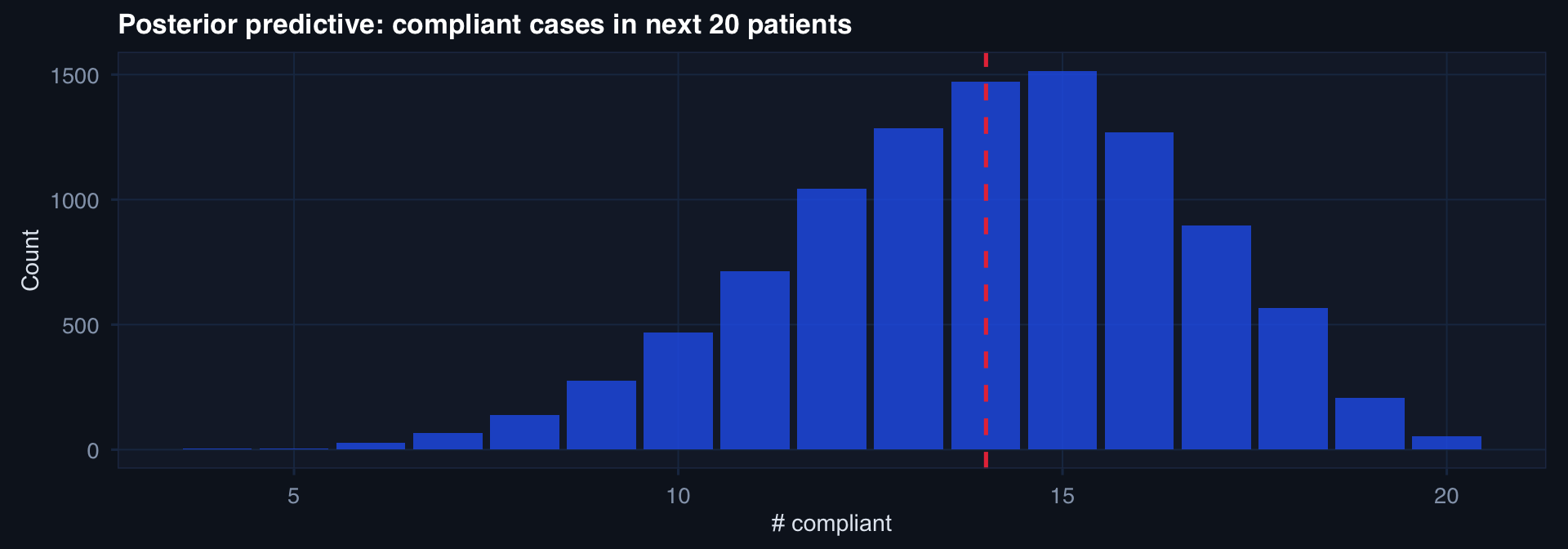
The posterior predictive propagates parameter uncertainty into outcome uncertainty — the right thing to give commanders.

Part 2

Monte Carlo Methods

When the math is intractable, simulate

The Core Monte Carlo Idea

\[E_p[g(X)] \approx \frac{1}{n}\sum_{i=1}^n g(X_i), \quad X_i \sim p(x)\]

Simulate → transform → average.

# Classic: estimate π by random points in unit square
n <- 10000
pts <- tibble(x=runif(n), y=runif(n)) |>
  mutate(inside = (x^2 + y^2) <= 1)

pi_est <- 4 * mean(pts$inside)
cat("Monte Carlo π estimate:", round(pi_est, 4), "\n")
Monte Carlo π estimate: 3.1264 
ggplot(pts[1:2000,], aes(x, y, color=inside)) +
  geom_point(size=0.4, alpha=0.6) +
  scale_color_manual(values=c("FALSE"="#e63946","TRUE"="#2563eb")) +
  coord_fixed() + theme_di() +
  labs(title=paste0("Estimating π via Monte Carlo (n=2000 shown) ≈ ", round(pi_est,3)))

MCMC: Sampling from Intractable Posteriors

When we can’t sample directly, build a Markov chain that converges to the target.

# Metropolis-Hastings targeting N(0,1)
n_iter <- 4000; chain <- numeric(n_iter); chain[1] <- 5
for(i in 2:n_iter) {
  prop <- rnorm(1, chain[i-1], 0.8)
  log_a <- dnorm(prop,log=TRUE) - dnorm(chain[i-1],log=TRUE)
  chain[i] <- if(log(runif(1)) < log_a) prop else chain[i-1]
}

tibble(iter=1:n_iter, value=chain) |>
  ggplot(aes(iter, value)) +
  geom_line(linewidth=0.35, color="#2563eb") +
  geom_hline(yintercept=0, linetype=2, color="#e63946") +
  labs(title="Metropolis-Hastings trace plot — targeting N(0,1)",
       x="Iteration", y="Sample") + theme_di()
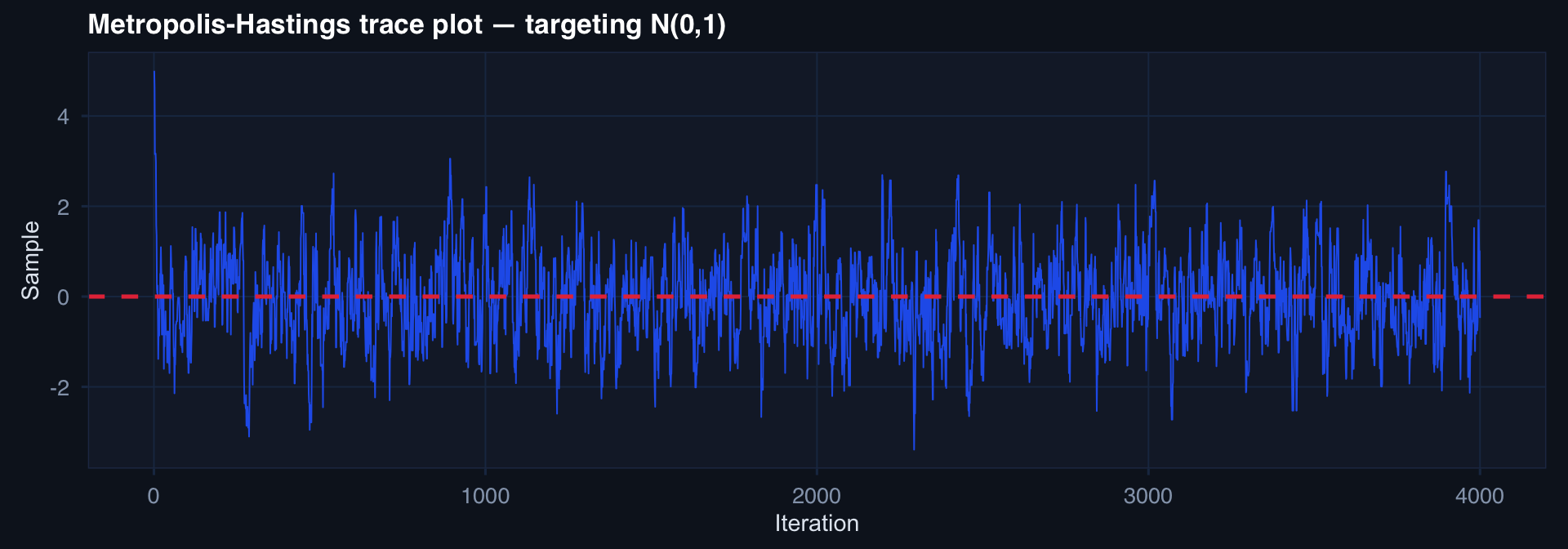
Bayesian trauma model: MCMC lets us fit hierarchical models with random effects for facility, time period, and injury pattern — posteriors that have no closed form but can be sampled.

Part 3

Entropy & Information Theory

Quantifying uncertainty in data and models

Shannon Entropy: Measuring Uncertainty

\[H(X) = -\sum_{x} P(x) \log_2 P(x)\]

Units: bits (base 2) or nats (base e)

entropy <- function(p) -sum(p[p>0] * log2(p[p>0]))
probs <- seq(0.01, 0.99, 0.01)
entropies <- sapply(probs, function(p) entropy(c(p, 1-p)))

tibble(p=probs, H=entropies) |>
  ggplot(aes(p, H)) +
  geom_line(linewidth=1.3, color="#2563eb") +
  geom_vline(xintercept=0.5, linetype=2, color="#e63946") +
  labs(title="Entropy of a binary outcome — max at p=0.5",
       x="P(event)", y="Entropy H (bits)") + theme_di()
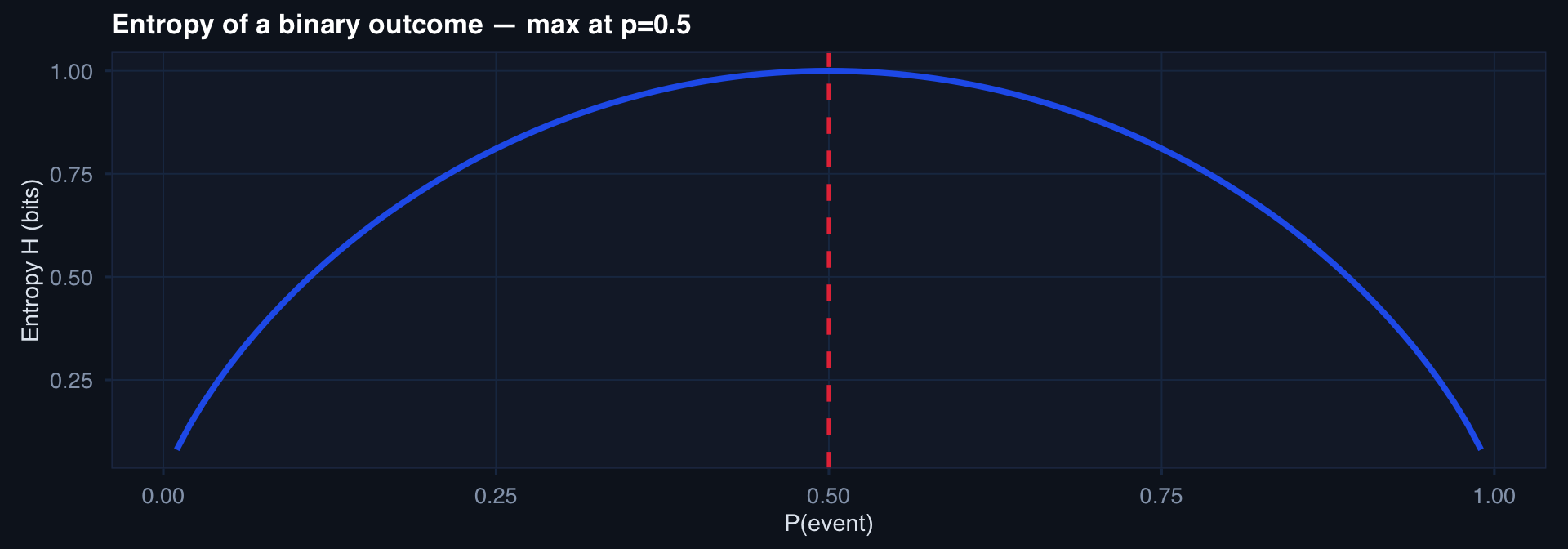
High entropy = high uncertainty (50/50 coin flip). Low entropy = low uncertainty (rare event we’re nearly certain about).

KL Divergence & Model Selection

\[D_{KL}(P \| Q) = \sum_x P(x) \log \frac{P(x)}{Q(x)} \geq 0\]

Interpretation: How much information is lost when Q is used to approximate P.

Applications in clinical AI:

  • Cross-entropy loss in neural networks = KL divergence from true labels
  • AIC/BIC penalize models with more parameters (information-theoretic basis)
  • WAIC (widely applicable information criterion) — Bayesian model comparison

Model selection for trauma outcomes: When comparing a logistic model vs. a flexible ML model for mortality, AIC/BIC/WAIC all operationalize the same idea: penalize complexity, reward fit. KL divergence is the underlying concept.

Lecture 4 — Key Takeaways

Bayesian Methods

  • Posterior ∝ Likelihood × Prior
  • Conjugate priors allow closed-form updating
  • Posterior predictive propagates uncertainty forward
  • Ideal for small-n clinical problems with prior knowledge

Monte Carlo

  • Simulate → transform → average
  • MCMC samples from intractable posteriors
  • Trace plots and R̂ diagnose convergence
  • Powers Bayesian modeling in practice

Entropy

  • H(X) measures average surprise/uncertainty
  • Maximum entropy = uniform distribution
  • KL divergence = information lost using wrong model
  • Foundation of cross-entropy loss, AIC, model selection

The meta-lesson: Bayesian + simulation methods together handle any posterior, regardless of analytic tractability.

Coming Up: Lecture 5

Regression — The Workhorse Models

“All models are wrong, but some are useful.” — Box

Posts 11, 12, 13:

  • Linear Regression — OLS, assumptions, diagnostics
  • Logistic Regression — binary outcomes, odds ratios, calibration
  • GLMs — the unified family connecting all regression models