Model Evaluation, Ensembles & Time Series

Applied Statistics for AI & Clinical Decision-Making — Lecture 9 of 10

Jonathan D. Stallings, PhD, MS

Data InDeed | dataindeed.org

2026-01-01

Accuracy is not a metric. It’s a number that hides everything that matters.

What You’ll Learn Today

Post 29 Metrics That Matter

  • ROC/AUC, precision-recall
  • Calibration
  • Decision curve analysis

Post 30 Ensembles

  • Bagging, boosting
  • Random forests
  • When and why they work

Post 17 Time Series

  • Autocorrelation
  • ARIMA framework
  • Seasonality & forecasting

Part 1

Metrics That Matter

Evaluating clinical AI like a biostatistician

Why “Accuracy” Is Misleading for Rare Events

# Trauma mortality dataset: 10% die
n <- 1000; pct_died <- 0.10
df_eval <- tibble(
  truth = c(rep(1, n*pct_died), rep(0, n*(1-pct_died))),
  pred_smart   = c(rbinom(n*pct_died, 1, 0.80), rbinom(n*(1-pct_died), 1, 0.15)),
  pred_naive   = rep(0, n)   # "never predict death" model
)

# Naive model accuracy:
cat("Naive (always 0) accuracy:", mean(df_eval$pred_naive == df_eval$truth), "\n")
Naive (always 0) accuracy: 0.9 
cat("Smart model accuracy:     ", mean(df_eval$pred_smart == df_eval$truth), "\n")
Smart model accuracy:      0.849 

A model that never predicts mortality achieves 90% accuracy on a dataset with 10% mortality. That model is useless — and dangerous. Never report accuracy alone for imbalanced clinical outcomes.

The ROC Curve and AUC

df_eval$pred_prob <- predict(
  glm(truth ~ rnorm(n) + rnorm(n), family=binomial, data=df_eval),
  type="response"
)
# Generate realistic predicted probabilities
df_eval$pred_prob <- plogis(-2 + 3*df_eval$truth + rnorm(n, 0, 1.5))

roc_obj <- roc(df_eval$truth, df_eval$pred_prob, quiet=TRUE)
plot(roc_obj, col="#2563eb", lwd=2,
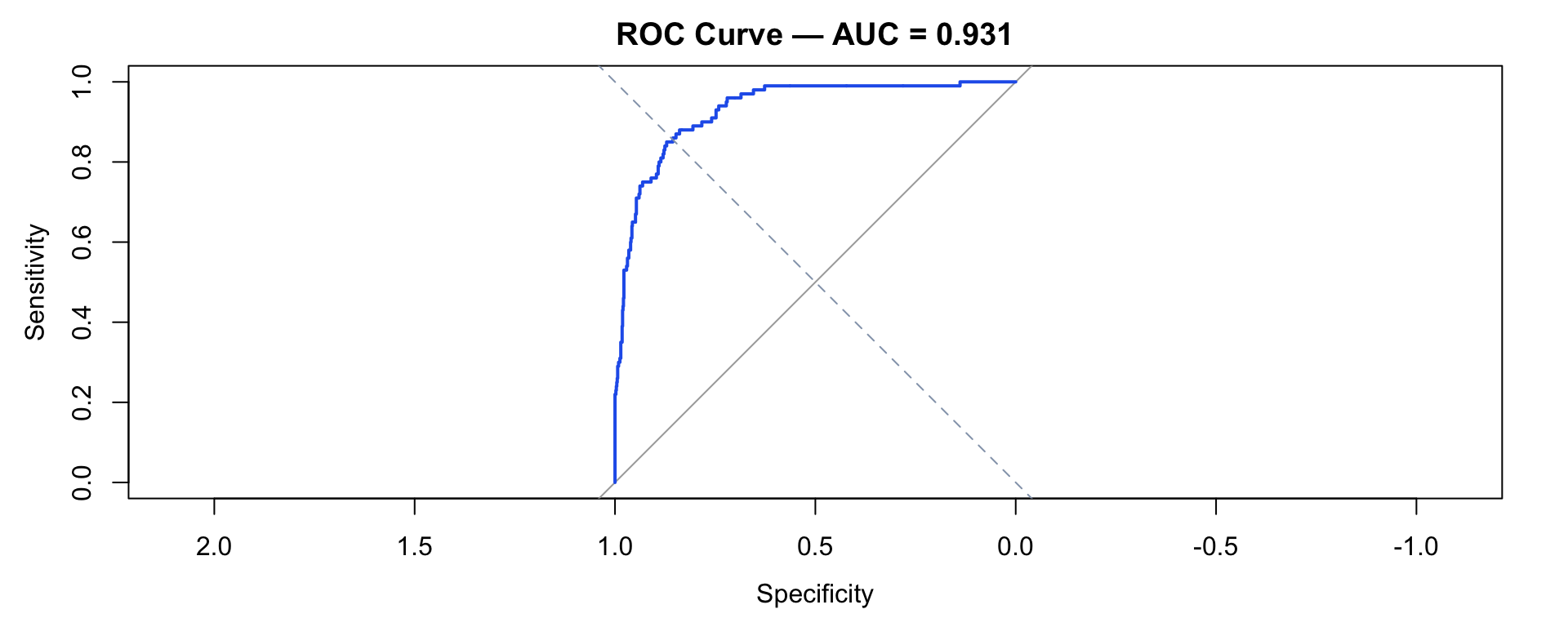
     main=paste0("ROC Curve — AUC = ", round(auc(roc_obj), 3)))
abline(a=0, b=1, lty=2, col="#94a3b8")

AUC = 0.5 → random; AUC = 1.0 → perfect; AUC > 0.75 → clinically useful range.

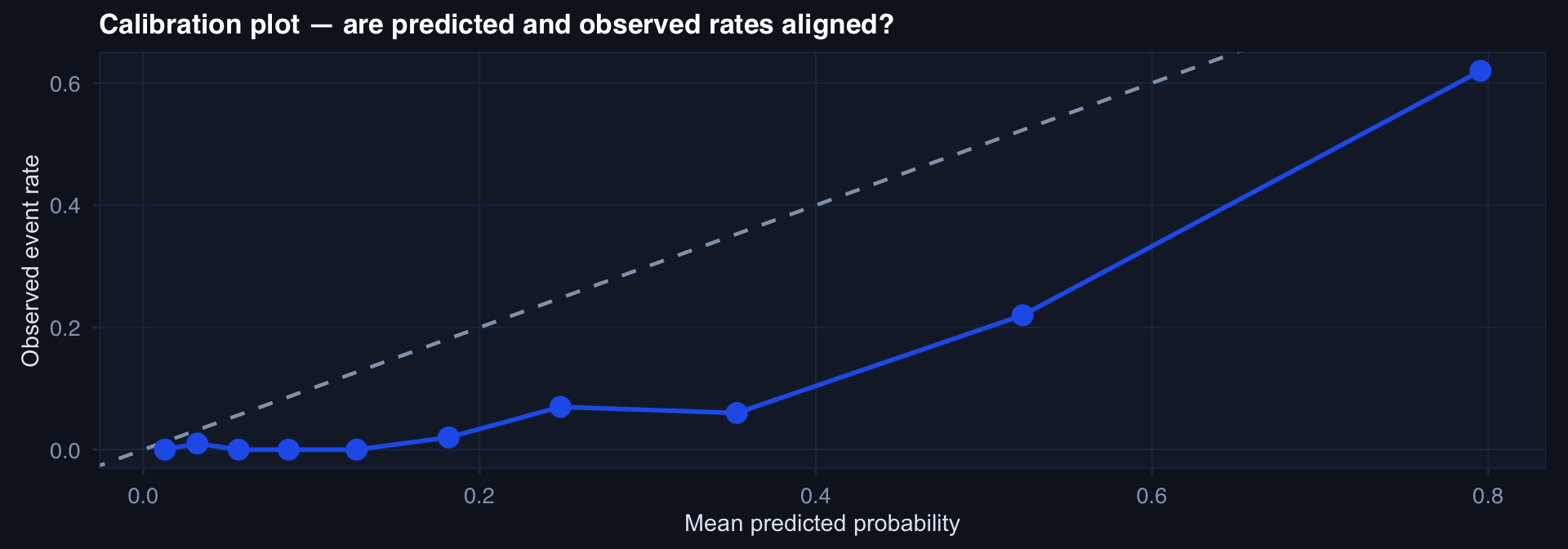
Calibration: Does 30% Risk Mean 30% Mortality?

df_eval |>
  dplyr::mutate(decile = ntile(pred_prob, 10)) |>
  dplyr::group_by(decile) |>
  dplyr::summarise(mean_pred=mean(pred_prob), obs_rate=mean(truth), .groups="drop") |>
  ggplot(aes(mean_pred, obs_rate)) +
  geom_abline(linetype=2, color="#94a3b8") +
  geom_point(size=4, color="#2563eb") +
  geom_line(color="#2563eb", linewidth=1) +
  labs(title="Calibration plot — are predicted and observed rates aligned?",
       x="Mean predicted probability", y="Observed event rate") + theme_di()

A model can discriminate well (high AUC) but be poorly calibrated — predicting 20% when true risk is 50%. Always report both.

Part 2

Ensemble Methods

Many weak models → one strong model

Why Ensembles Work

Two sources of error in any single model:

  • Bias — systematic wrong direction
  • Variance — random fluctuation across training sets

Averaging independent models reduces variance without increasing bias.

Bagging (Bootstrap AGGregating)

  • Train many models on bootstrap samples
  • Average predictions
  • Reduces variance
  • Random Forests = bagging + random feature subsets

Boosting

  • Train sequentially, each model corrects the previous
  • Reduces bias
  • XGBoost, LightGBM, AdaBoost
  • Risk of overfitting if not regularized

Variable Importance via Lasso Coefficient Path

library(glmnet)
n <- 500
df_rf <- tibble::tibble(
  iss=rnorm(n,28,12), sbp=rnorm(n,110,20),
  gcs=rnorm(n,13,3), age=rnorm(n,35,15),
  died=rbinom(n,1,plogis(-3+0.05*iss-0.02*sbp-0.1*gcs+0.02*age))
)
X_mat <- model.matrix(died ~ iss + sbp + gcs + age, data=df_rf)[,-1]
cv_fit <- cv.glmnet(X_mat, df_rf$died, family="binomial", alpha=1, nfolds=10)

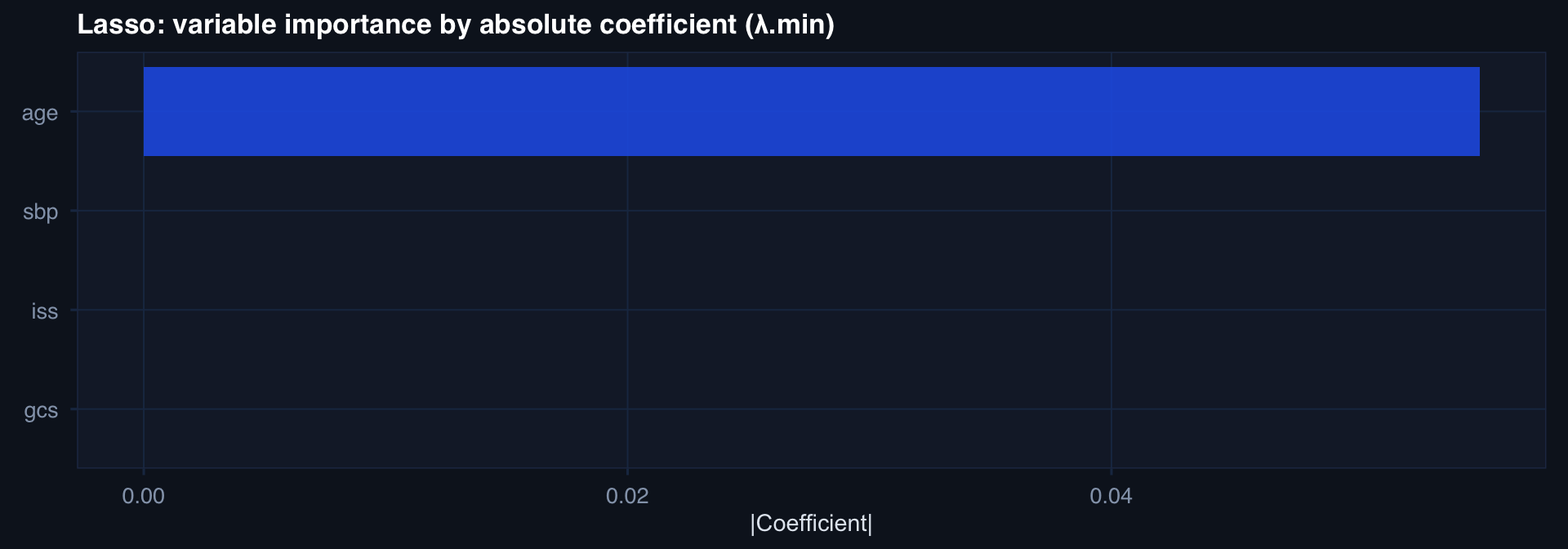
# Variable importance: absolute coefficient at lambda.min
coef_df <- as.matrix(coef(cv_fit, s="lambda.min"))[-1,,drop=FALSE]
tibble::tibble(
  Feature    = rownames(coef_df),
  Importance = abs(coef_df[,1])
) |>
  dplyr::arrange(dplyr::desc(Importance)) |>
  ggplot2::ggplot(ggplot2::aes(x=reorder(Feature,Importance), y=Importance)) +
  ggplot2::geom_col(fill="#2563eb", alpha=0.85) +
  ggplot2::coord_flip() +
  ggplot2::labs(title="Lasso: variable importance by absolute coefficient (λ.min)",
                x=NULL, y="|Coefficient|") +
  theme_di()
Part 3

Time Series

When observations are ordered in time

Why Time Series Is Different

Ordinary regression assumes independence.

Time series data is autocorrelated — observations near in time are similar.

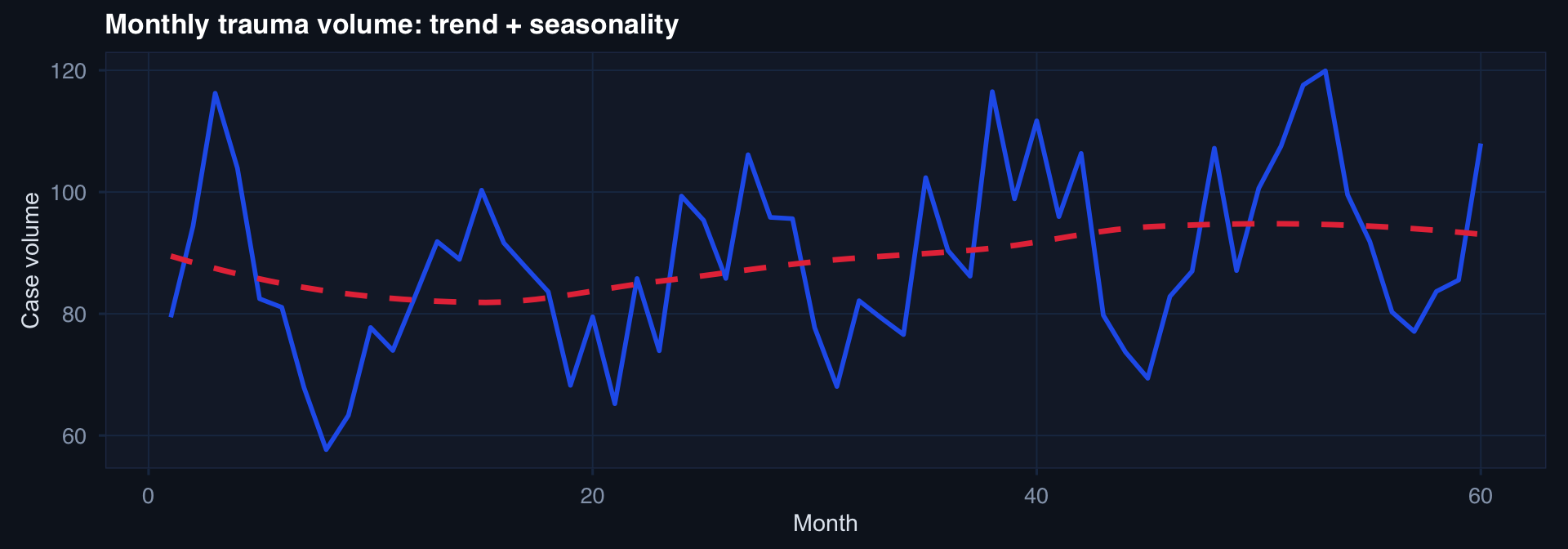
# Monthly trauma volume — seasonal + trend
time_pts <- 60
ts_data  <- tibble(
  month = 1:time_pts,
  volume = 80 + 0.3*month + 15*sin(2*pi*month/12) + rnorm(time_pts,0,8)
)
ggplot(ts_data, aes(month, volume)) +
  geom_line(linewidth=1, color="#2563eb") +
  geom_smooth(method="loess", se=FALSE, color="#e63946", linetype=2) +
  labs(title="Monthly trauma volume: trend + seasonality",
       x="Month", y="Case volume") + theme_di()

Registry monitoring: Monthly CPG compliance rates have seasonal patterns (summer injury patterns ≠ winter), baseline trends as protocols improve, and autocorrelation. Standard t-tests are invalid — time series models are required.

ARIMA: The Workhorse Time Series Model

ARIMA(p, d, q)

  • AR(p): outcome depends on its own p lags
  • I(d): d-order differencing for stationarity
  • MA(q): outcome depends on q past errors
ts_obj <- ts(ts_data$volume, frequency=12)
fit_arima <- forecast::auto.arima(ts_obj)
summary(fit_arima)
Series: ts_obj 
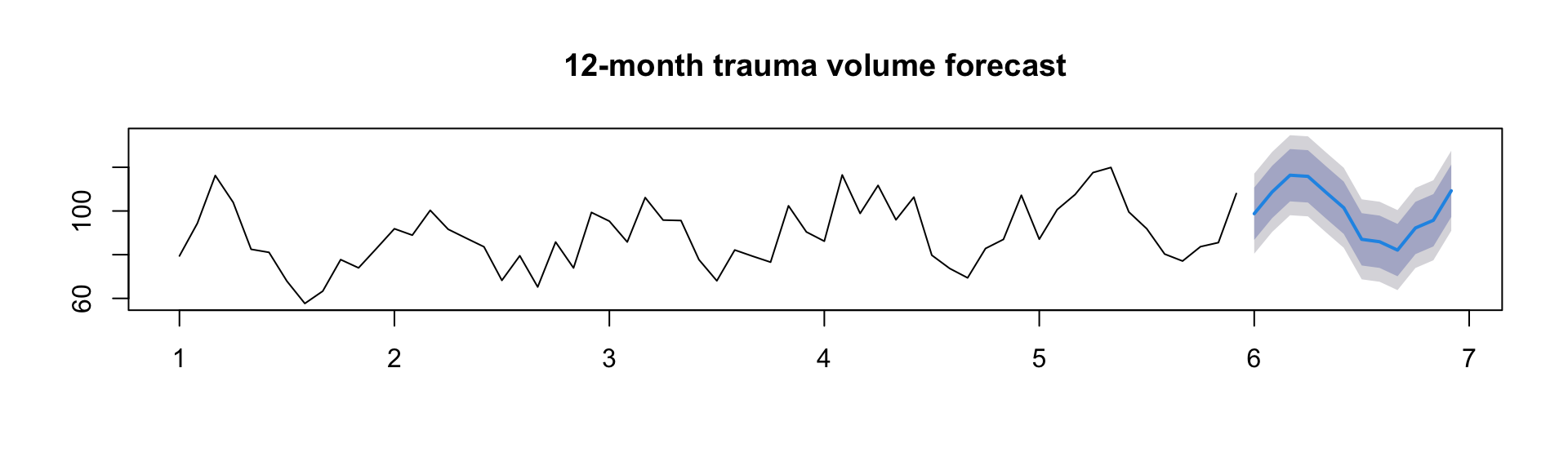
ARIMA(0,0,0)(0,1,1)[12] with drift 

Coefficients:
         sma1   drift
      -0.8258  0.3161
s.e.   0.5162  0.0644

sigma^2 = 82.69:  log likelihood = -178.96
AIC=363.93   AICc=364.47   BIC=369.54

Training set error measures:
                     ME    RMSE      MAE        MPE     MAPE      MASE
Training set -0.1237474 7.96191 5.968365 -0.5790955 6.469361 0.6388639
                   ACF1
Training set -0.0949034
forecast::forecast(fit_arima, h=12) |> plot(main="12-month trauma volume forecast")

Lecture 9 — Key Takeaways

Evaluation Metrics

  • Accuracy fails for imbalanced outcomes
  • AUC = discrimination (rank ordering)
  • Calibration = confidence accuracy
  • Decision curve analysis = net benefit by threshold
  • Always report both discrimination AND calibration

Ensembles

  • Bagging reduces variance (Random Forests)
  • Boosting reduces bias (XGBoost)
  • Variable importance → data-driven feature selection
  • Need cross-validation to tune — not training error

Time Series

  • Autocorrelation violates independence assumption
  • ARIMA(p,d,q) handles trend + autocorrelation
  • Seasonality → SARIMA or seasonal decomposition
  • Forecast + uncertainty interval, not point prediction

The meta-lesson: The metric you optimize shapes what your model learns to do. Choose metrics that reflect clinical consequences, not statistical convenience.

Coming Up: Lecture 10

Mathematical Foundations of Modern AI

Posts 24, 25, 26:

  • Optimization — gradient descent, the engine of ML training
  • Linear Algebra — vectors, matrices, SVD
  • Calculus — derivatives, chain rule, backpropagation

These are the mathematical structures that sit underneath every model we’ve covered in this series.