Probability Foundations

Applied Statistics for AI & Clinical Decision-Making — Lecture 1 of 10

Jonathan D. Stallings, PhD, MS

Data InDeed | dataindeed.org

2026-01-01

Probability is not a prerequisite.

It is the language.

What You’ll Learn Today

Three posts · One lecture · ~50 minutes

Post 1 How Probability Powers AI

  • What probability is
  • Bayes’ theorem
  • Contingency tables

Post 2 Random Variables

  • Discrete vs. continuous
  • Expected value & variance
  • Distributions as models

Post 3 Key Distributions

  • Normal, Bernoulli, Poisson
  • Clinical applications
  • Choosing the right one

Part 1

How Probability Powers AI

From spam filters to clinical triage

Why Probability? The Honest Answer

AI does not eliminate uncertainty. It formalizes decisions under uncertainty.

Every AI/ML system that outputs a “prediction” is really computing a probability:

  • Email classifier: P(spam | features)
  • Triage algorithm: P(deterioration | vitals, labs)
  • Diagnostic model: P(injury | imaging + mechanism)

In trauma care — vitals may be incomplete, mechanism may be wrong, hemorrhage may be occult.

Probability gives us a disciplined way to reason under incomplete information.

Kolmogorov’s Three Axioms

All of probability theory rests on three rules:

Axiom 1 (Non-negativity): \(P(A) \geq 0\)

Axiom 2 (Normalization): \(P(S) = 1\)

Axiom 3 (Additivity): If A, B are mutually exclusive: \(P(A \cup B) = P(A) + P(B)\)

Why they matter for AI: A classifier that outputs incoherent probabilities (e.g., probabilities that don’t sum to 1) is mathematically invalid, not just poorly calibrated.

Joint, Marginal & Conditional Probability

The three types you’ll use constantly:

Type Definition Example
Joint \(P(A \cap B)\) P(contains “free” AND is spam)
Marginal \(P(A) = \sum_B P(A,B)\) P(spam) regardless of words
Conditional \(P(A \mid B) = \frac{P(A,B)}{P(B)}\) P(spam | contains “free”)

Trauma translation:

  • Marginal = overall mortality rate in the registry
  • Conditional = mortality given hemorrhagic shock AND no prehospital TXA
  • Joint = probability of both shock AND ICU admission

Contingency Tables: Probability Engines

A 2×2 table gives you the entire joint probability space:

email_df <- tibble::tibble(
  contains_free = c("Yes","Yes","Yes","Yes","No","No","No","No","Yes","No"),
  spam          = c("Yes","Yes","No","Yes","No","No","Yes","No","Yes","No")
)

ct <- table(email_df$contains_free, email_df$spam)
prop.table(ct)        # joint probabilities
     
       No Yes
  No  0.4 0.1
  Yes 0.1 0.4

Row sums → marginal P(contains_free) Column sums → marginal P(spam) Each cell → joint P(contains_free, spam)

Bayes’ Theorem: The Engine of Belief Updating

\[P(\theta \mid \text{data}) = \frac{P(\text{data} \mid \theta) \cdot P(\theta)}{P(\text{data})}\]

Posterior ∝ Likelihood × Prior

In clinical triage:

  • Prior — baseline injury rate in this patient population
  • Likelihood — how often this vital-sign pattern occurs given injury
  • Posterior — updated probability of injury given what you’ve observed

Why it matters for AI:

Every Bayesian model, naive Bayes classifier, and probabilistic neural network is applying this one formula.

Quick R: Bayes’ Theorem from a Table

# Simulate: 1000 trauma patients, 15% have occult hemorrhage
# Positive FAST exam sensitivity = 0.85, specificity = 0.92

n <- 10000
p_hem    <- 0.15
sens     <- 0.85
spec     <- 0.92

# Compute positive predictive value (PPV) — Bayes in one formula
p_pos_given_hem    <- sens
p_pos_given_no_hem <- 1 - spec

p_pos <- p_pos_given_hem * p_hem + p_pos_given_no_hem * (1 - p_hem)

ppv <- (p_pos_given_hem * p_hem) / p_pos
tibble::tibble(PPV = round(ppv, 3), FDR = round(1 - ppv, 3))
# A tibble: 1 × 2
    PPV   FDR
  <dbl> <dbl>
1 0.652 0.348

Part 2

Random Variables

The mathematical bridge between events and numbers

What Is a Random Variable?

A random variable maps outcomes of a random process to numbers we can compute with.

Discrete random variables Take countable values:

  • Number of transfusions in 24 hrs
  • Injury Severity Score (ISS)
  • 30-day readmission (0 or 1)

Continuous random variables Take any value in a range:

  • Systolic blood pressure
  • Time to OR
  • Lab values (lactate, Hgb)

The distribution of a random variable tells you how likely each value (or range of values) is.

Expected Value and Variance

Two numbers that summarize any distribution:

Expected value (mean): \(E[X] = \sum_x x \cdot P(X=x)\)

Variance: \(\text{Var}(X) = E[(X - \mu)^2]\)

Standard deviation: \(\text{SD}(X) = \sqrt{\text{Var}(X)}\)

iss_sim <- tibble::tibble(
  iss = c(9,16,25,9,4,36,16,25,9,16,25,75,9,4,16)
)
iss_sim |>
  dplyr::summarise(
    mean_iss  = mean(iss),
    sd_iss    = sd(iss),
    var_iss   = var(iss)
  )
# A tibble: 1 × 3
  mean_iss sd_iss var_iss
     <dbl>  <dbl>   <dbl>
1     19.6   17.8    315.

Why Variance Matters in Clinical AI

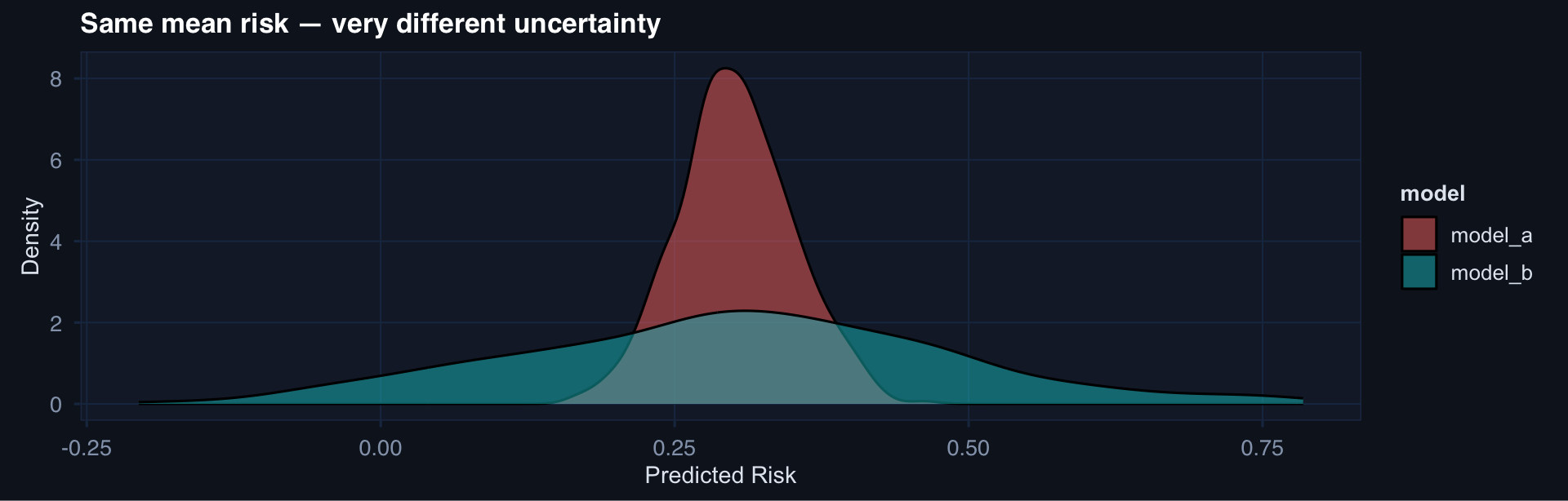
Two models with the same mean prediction can have very different clinical implications:

set.seed(123)
preds <- tibble::tibble(
  model_a = rnorm(500, mean = 0.3, sd = 0.05),
  model_b = rnorm(500, mean = 0.3, sd = 0.18)
) |>
  tidyr::pivot_longer(everything(), names_to = "model", values_to = "pred_risk")

ggplot2::ggplot(preds, ggplot2::aes(x = pred_risk, fill = model)) +
  ggplot2::geom_density(alpha = 0.5) +
  ggplot2::labs(title = "Same mean risk — very different uncertainty",
                x = "Predicted Risk", y = "Density") +
  theme_di()
Part 3

Key Probability Distributions

The models behind the data

The Distribution Zoo: Which to Use When

Distribution Data type Classic use in trauma/AI
Bernoulli Binary outcome (0/1) Mortality, complication (yes/no)
Binomial Count of successes in n trials # of CPG-compliant cases out of 20
Poisson Count of rare events ED arrivals per hour, rare complications
Normal Continuous, symmetric Lab values, physiologic scores
Exponential Time until event Time to hemorrhage control
Beta Proportions (0–1) Prior on compliance rate
Gamma / Weibull Skewed positive continuous Survival time, ICU LOS

The Normal Distribution: Why It’s Everywhere

x <- seq(-4, 4, length.out = 300)

tibble::tibble(x = x, y = dnorm(x)) |>
  ggplot2::ggplot(ggplot2::aes(x, y)) +
  ggplot2::geom_line(linewidth = 1.2, color = "#2563eb") +
  ggplot2::geom_area(fill = "#2563eb", alpha = 0.12) +
  ggplot2::labs(title = "Standard Normal N(0,1)",
                x = "Standard deviations from mean", y = "Density") +
  theme_di()
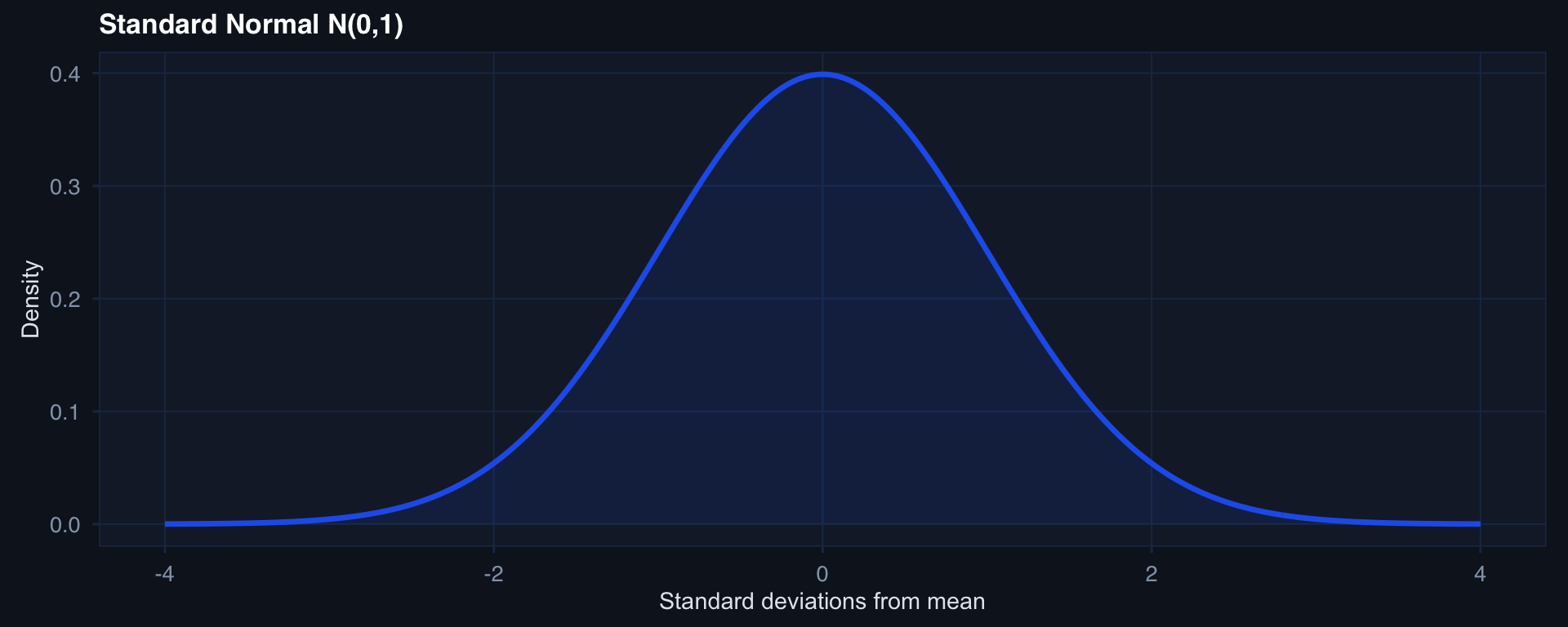
The 68-95-99.7 rule:

  • 68% of data within ±1 SD
  • 95% within ±2 SD
  • 99.7% within ±3 SD

It’s ubiquitous because of the CLT — sums of many independent variables converge to Normal (Lecture 2).

Clinical: Systolic BP, hematocrit, temperature — all approximately Normal in stable populations.

Poisson: When Events Are Rare and Independent

lambdas <- c(1, 3, 8)
pois_df <- purrr::map_dfr(lambdas, function(l) {
  tibble::tibble(
    x = 0:20,
    prob = dpois(0:20, lambda = l),
    lambda = paste0("λ = ", l)
  )
})

ggplot2::ggplot(pois_df, ggplot2::aes(x, prob, fill = lambda)) +
  ggplot2::geom_col(position = "dodge", alpha = 0.85) +
  ggplot2::scale_fill_brewer(palette = "Blues") +
  ggplot2::labs(title = "Poisson distribution — three rates",
                x = "Count", y = "P(X = x)", fill = NULL) +
  theme_di()
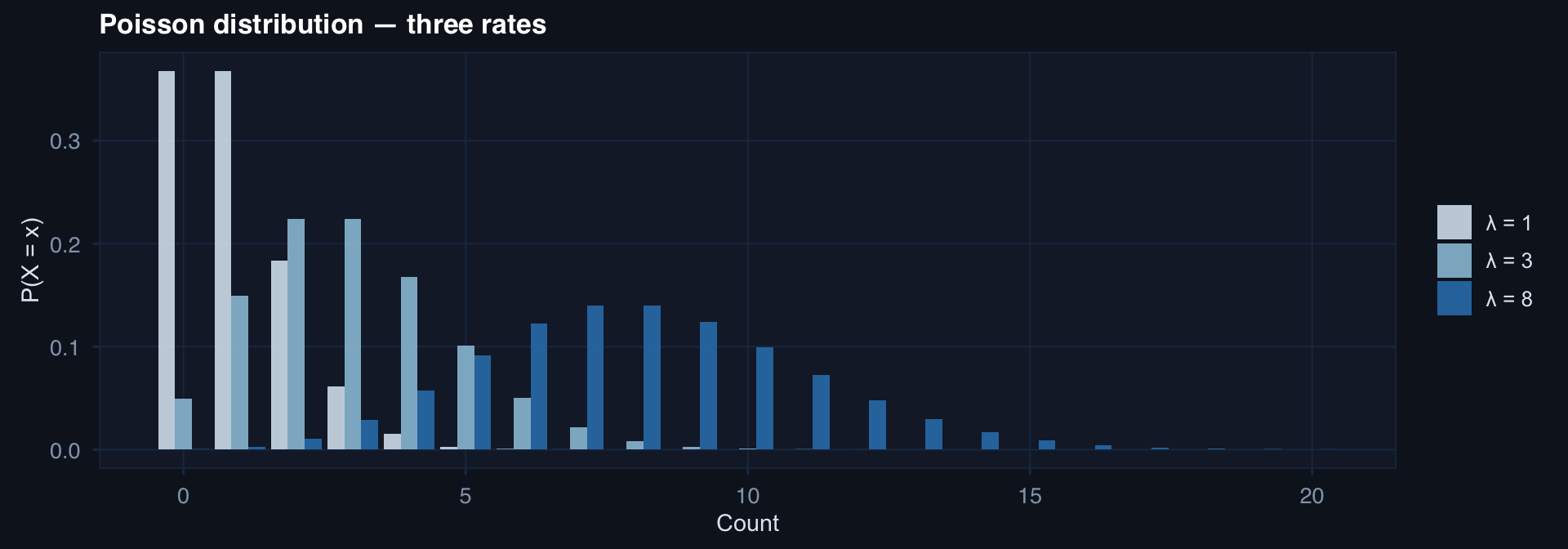
Clinical application: Rare adverse events — anastomotic leaks, intraoperative cardiac arrest, battlefield tourniquet failures. When mean ≈ variance and events are independent, Poisson is the right model.

Choosing a Distribution: The Decision Tree

Is the outcome binary (0/1)?
  → Bernoulli / Binomial

Is the outcome a count?
  → Poisson (if mean ≈ variance)
  → Negative Binomial (if overdispersed)

Is the outcome time-to-event?
  → Exponential / Weibull / Cox (Lecture 6)

Is the outcome continuous and symmetric?
  → Normal

Is the outcome continuous and right-skewed?
  → Gamma / Log-Normal

Is the outcome a proportion (0–1)?
  → Beta (as a prior) / logistic regression

Lecture 1 — Key Takeaways

Probability

  • Three axioms make probability coherent
  • Joint, marginal, conditional are always relationships between the same numbers
  • Bayes’ theorem formalizes how evidence updates belief

Random Variables

  • Map events to numbers
  • Discrete vs. continuous is a modeling choice
  • E[X] and Var(X) summarize any distribution

Distributions

  • Bernoulli/Binomial → binary and count outcomes
  • Normal → symmetric continuous data
  • Poisson → rare, independent events
  • Exponential/Weibull → time-to-event

Clinical Application

  • Every risk score is a posterior probability
  • Base rates matter enormously
  • Distribution choice is a scientific claim, not a formality

Coming Up: Lecture 2

The Laws That Make Statistics Work

Posts 04, 05, 06:

  • CLT — why sample means become Normal, regardless of original distribution
  • LLN — why bigger samples converge to truth
  • Sampling — strategies, bias, sample size, design implications

These three results are why statistics can make reliable inferences from incomplete data.

Resources