Mathematical Foundations of Modern AI

Applied Statistics for AI & Clinical Decision-Making — Lecture 10 of 10

Jonathan D. Stallings, PhD, MS

Data InDeed | dataindeed.org

2026-01-01

Every model we’ve covered runs on these three engines: optimization, linear algebra, and calculus.

What You’ll Learn Today — And Why Now

Post 24 Optimization

  • Gradient descent
  • Learning rate
  • Stochastic & mini-batch

Post 25 Linear Algebra

  • Vectors & matrices
  • Eigendecomposition
  • SVD

Post 26 Calculus

  • Derivatives & gradients
  • Chain rule
  • Automatic differentiation

We cover these last because you’ve now seen them in action. Optimization powered your logistic regression. Linear algebra powered PCA. Calculus powered every gradient you’ve implicitly computed.

Part 1

Optimization

The engine that trains every model

What We’re Optimizing

Every model training is an optimization problem:

\[\hat{\theta} = \arg\min_\theta \mathcal{L}(\theta; \text{data})\]

Model Loss function \(\mathcal{L}\)
Linear regression Mean squared error
Logistic regression Binary cross-entropy
Lasso RSS + λ|β|₁
Neural network Cross-entropy or MSE
Cox model Negative partial log-likelihood

Gradient descent is the universal algorithm for finding the minimum when an analytic solution doesn’t exist.

Gradient Descent: Step Downhill

\[\theta_{t+1} = \theta_t - \alpha \nabla_\theta \mathcal{L}(\theta_t)\]

\(\alpha\) = learning rate (step size)
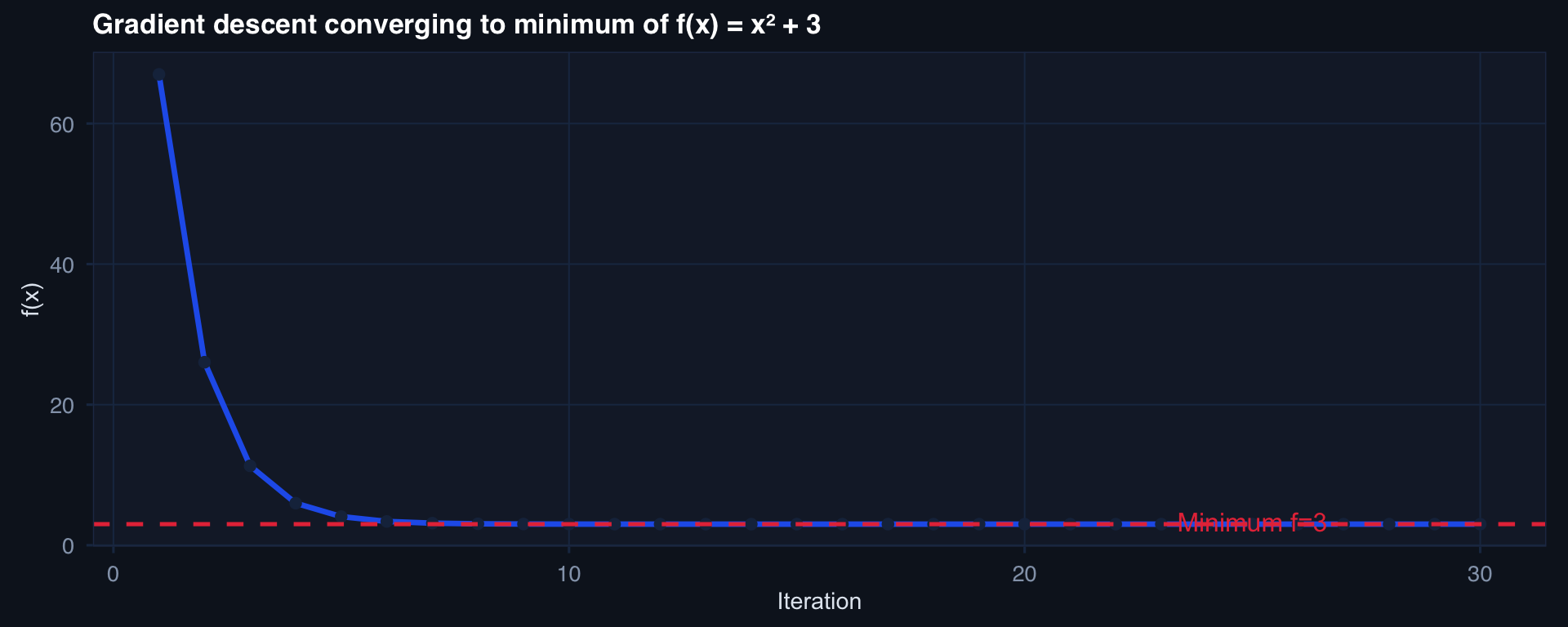
# Simple example: minimize f(x) = x^2 + 3
x_path <- numeric(30); x_path[1] <- 8; lr <- 0.2
for(i in 2:30) x_path[i] <- x_path[i-1] - lr * 2 * x_path[i-1]

tibble(iter=1:30, x=x_path, f=x_path^2+3) |>
  ggplot(aes(iter, f)) +
  geom_line(linewidth=1.2, color="#2563eb") +
  geom_point(size=2, color="#1b2e4b") +
  geom_hline(yintercept=3, linetype=2, color="#e63946") +
  annotate("text",x=25,y=3.3,label="Minimum f=3",color="#e63946") +
  labs(title="Gradient descent converging to minimum of f(x) = x² + 3",
       x="Iteration", y="f(x)") + theme_di()

Learning Rate: The Most Important Hyperparameter

run_gd <- function(lr, n_iter=40) {
  x <- 8
  sapply(1:n_iter, function(i) { x <<- x - lr * 2 * x; x^2 + 3 })
}
tibble(iter=rep(1:40,3),
       loss=c(run_gd(0.05), run_gd(0.2), run_gd(0.6)),
       lr=rep(c("Too small (0.05)","Just right (0.2)","Too large (0.6)"), each=40)) |>
  ggplot(aes(iter, loss, color=lr)) +
  geom_line(linewidth=1) +
  scale_y_log10() +
  scale_color_manual(values=c("#94a3b8","#2563eb","#e63946")) +
  labs(title="Learning rate: too small = slow, too large = diverges",
       x="Iteration", y="Loss (log scale)", color=NULL) + theme_di()
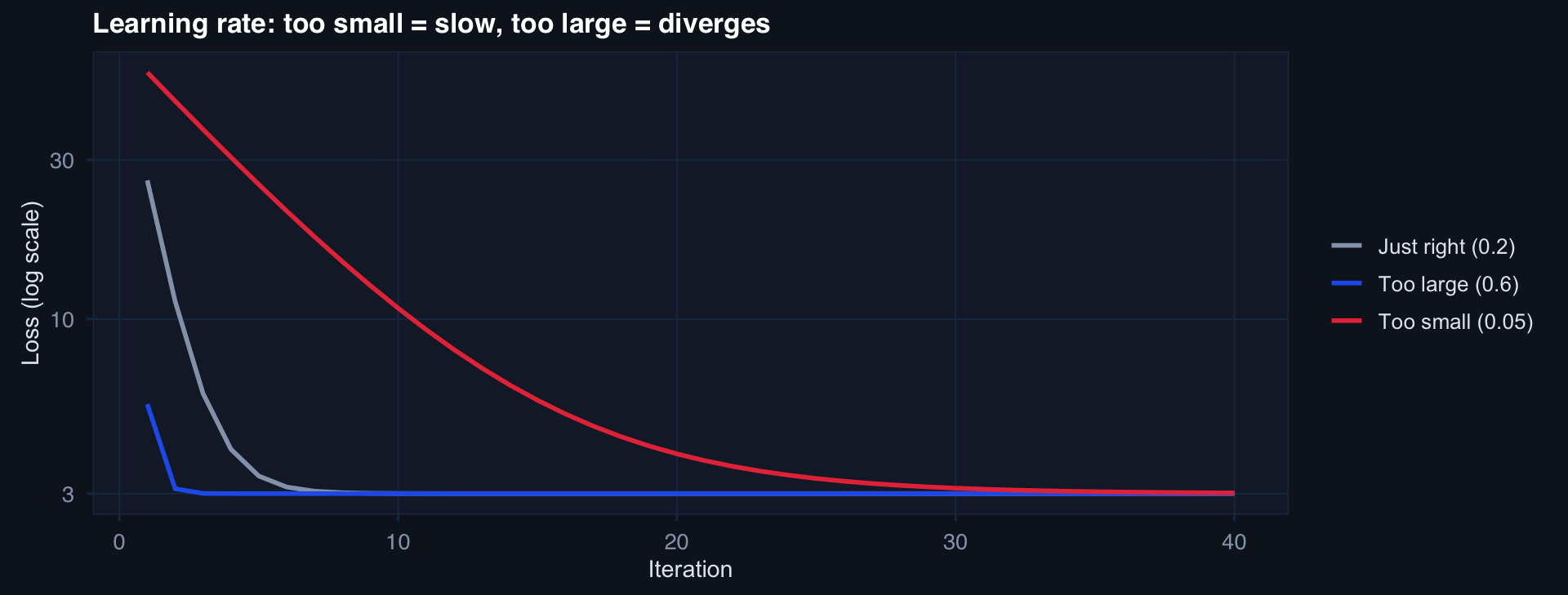
Too small → converges very slowly. Too large → overshoots minimum, diverges. Just right → fast, stable convergence.

Part 2

Linear Algebra

The data structure underneath every computation

Why Linear Algebra Is Everywhere

Every dataset is a matrix. Every prediction is a matrix operation.

Linear regression: \(\hat{y} = X\hat{\beta} = X(X^\top X)^{-1}X^\top y\)

PCA: \(X = U D V^\top\) (SVD)

Neural forward pass: \(a^{(l)} = \sigma(W^{(l)} a^{(l-1)} + b^{(l)})\)

X <- matrix(c(1,2,3,4,5,6), nrow=3, byrow=TRUE)
cat("X:\n"); print(X)
X:
     [,1] [,2]
[1,]    1    2
[2,]    3    4
[3,]    5    6
cat("\nX'X:\n"); print(t(X) %*% X)

X'X:
     [,1] [,2]
[1,]   35   44
[2,]   44   56
cat("\nSingular values:", round(svd(X)$d, 3))

Singular values: 9.526 0.514

SVD: The Most Important Matrix Decomposition

\[X = U D V^\top\]

  • \(U\): left singular vectors (row space)
  • \(D\): singular values (importance of each direction)
  • \(V\): right singular vectors (column space)
# Simulate patient × feature matrix, reconstruct with k=2 components
n <- 100; p <- 8
X_patients <- scale(matrix(rnorm(n*p), n, p))
svd_fit <- svd(X_patients)

# Low-rank approximation with k=2
k <- 2
X_approx <- svd_fit$u[,1:k] %*% diag(svd_fit$d[1:k]) %*% t(svd_fit$v[,1:k])
cat("Variance explained by 2 components:",
    round(sum(svd_fit$d[1:2]^2) / sum(svd_fit$d^2), 3))
Variance explained by 2 components: 0.36

PCA is SVD on the centered data matrix. Understanding SVD means understanding PCA, matrix completion, recommendation systems, and latent semantic analysis.

Part 3

Calculus

Derivatives as the language of change

The Derivative: Rate of Change

\[f'(x) = \lim_{h \to 0} \frac{f(x+h) - f(x)}{h}\]

For a multivariable function: gradient \(\nabla_\theta \mathcal{L} = \left[\frac{\partial \mathcal{L}}{\partial \theta_1}, \dots, \frac{\partial \mathcal{L}}{\partial \theta_k}\right]^\top\)

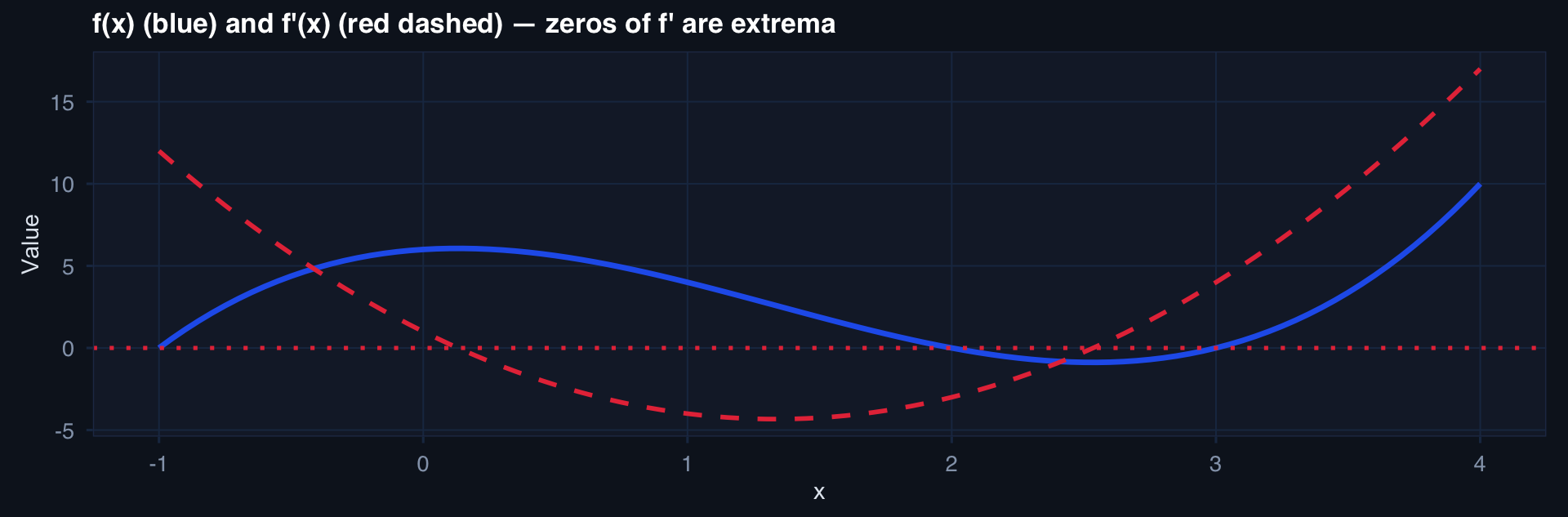
f   <- function(x) x^3 - 4*x^2 + x + 6
df  <- function(x) 3*x^2 - 8*x + 1

x_grid <- seq(-1, 4, 0.05)
tibble(x=x_grid, f=f(x_grid), deriv=df(x_grid)) |>
  ggplot(aes(x)) +
  geom_line(aes(y=f), color="#2563eb", linewidth=1.2) +
  geom_line(aes(y=deriv), color="#e63946", linewidth=1, linetype=2) +
  geom_hline(yintercept=0, linetype=3) +
  labs(title="f(x) (blue) and f'(x) (red dashed) — zeros of f' are extrema",
       y="Value") + theme_di()

The Chain Rule: How Backprop Works

\[\frac{d}{dx}[f(g(x))] = f'(g(x)) \cdot g'(x)\]

In neural networks: backpropagation applies the chain rule layer by layer, from loss back to first-layer weights.

# Automatic differentiation concept — numerical illustration
# dL/dw = dL/da × da/dz × dz/dw
dL_da  <- -2.5    # gradient from loss
da_dz  <- 0.18    # sigmoid derivative at activation z
dz_dw  <- 1.3     # input value = dz/dw for linear layer

dL_dw  <- dL_da * da_dz * dz_dw
cat("Chain rule: dL/dw =", dL_da, "×", da_dz, "×", dz_dw, "=", round(dL_dw,4))
Chain rule: dL/dw = -2.5 × 0.18 × 1.3 = -0.585

This same product of derivatives, applied at every weight in a deep network, is backpropagation. The chain rule is why neural networks are trainable.

Lecture 10 — Key Takeaways

Optimization

  • GD: θ ← θ − α∇L
  • Learning rate controls speed and stability
  • SGD/mini-batch GD for large datasets
  • Adam optimizer adapts learning rate per parameter

Linear Algebra

  • Data = matrix; prediction = matrix multiplication
  • SVD underlies PCA, compression, latent representation
  • Eigenvalues tell you dominant variance directions
  • Matrix inversion is numerically fragile — prefer factorizations

Calculus

  • Derivative = instantaneous rate of change
  • Gradient = direction of steepest ascent in multivariable space
  • Chain rule → backpropagation → neural network training
  • Automatic differentiation (PyTorch, JAX, Stan) does this for you

The meta-lesson: You can use every model in this course without deriving these from scratch. But knowing the machinery makes you a better analyst — you understand what can go wrong and why.

Series Complete — What You Can Do Now

10 lectures · 30 posts · ~8.5 hours

Foundation (Lectures 1–3)

  • Reason probabilistically under uncertainty
  • Estimate parameters and communicate uncertainty honestly
  • Avoid the p-value traps that corrupt most clinical research

Modeling (Lectures 4–6)

  • Build Bayesian models with priors from clinical knowledge
  • Fit regression models appropriate to the outcome type
  • Analyze time-to-event data correctly with censoring

Modern ML (Lectures 7–9)

  • Navigate high-dimensional data without overfitting
  • Evaluate models honestly — discrimination AND calibration
  • Build ensembles that outperform single models

Foundations (Lecture 10)

  • Understand what gradient descent is actually doing
  • Read linear algebra in model outputs (PCA, SVD)
  • Trace a backpropagation derivative by hand

Coming next: Advanced Statistics Series → Experimental Design Series

The Applied Statistics Series — Full Reading List